2025-12-11 ハーバード大学
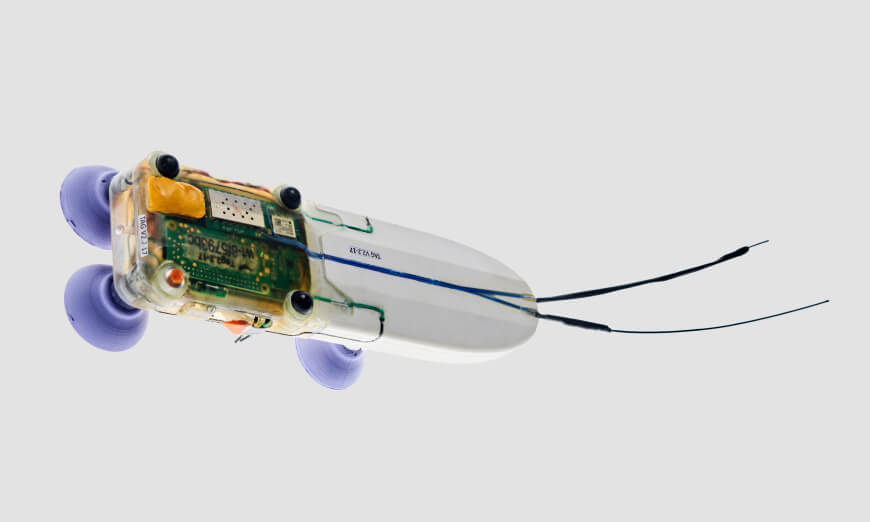
Detail view of the Project CETI bio-logger. Photo credit: Spencer Lowell
<関連情報>
- https://seas.harvard.edu/news/2025/12/tapping-whale-talk
- https://journals.plos.org/plosone/article?id=10.1371/journal.pone.0337093
- https://medibio.tiisys.com/168849/
- https://medibio.tiisys.com/126671/
クジラ類の行動とコミュニケーションを研究するためのオープンソースのバイオロガー An open-source bio-logger for studying cetacean behavior and communication
Daniel M. Vogt,Joseph DelPreto,Michael Salino-Hugg,Matthew R. Cummings,Michael A. Bell,Aidan Kenny,Peter Malkin,Alyssa M. Hernandez,Andrew L. Wright,Molly A. Duncan,Matthew R. Davidsen,Kaveet Grewal,Saksham Ahuja, [ … ],Robert J. Wood
PLOS One Published: December 11, 2025
DOI:https://doi.org/10.1371/journal.pone.0337093
Abstract
Over the past decade, bioacoustics associated with diverse marine life has become the focus of increasing research. While fixed acoustic devices play important roles in characterizing localized soundscapes, animal-worn devices that record audio alongside physiological metrics provide richer portals to understanding cetacean communication and characterizing sounds in their environment. To facilitate scaling the collection of such multimodal datasets for deep learning applications and to encourage rapid prototyping for new recording capabilities, we present an open-source non-invasive bio-logger that can be deployed on marine animals to record high-quality audio synchronized with an extensible suite of behavioral and environmental sensors. The current implementation is tailored to investigating sperm whale communication and biology. It features four suction cups, three high-bandwidth synchronized hydrophones for audio analysis including directionality, GPS logging and transmission, and sensors for pressure, motion, orientation, temperature, and light. Its hardware and software are both open-source, with designs, fabrication details, and code available online. Lab-based experiments characterize and validate performance including shear adhesion forces, withstanding pressures equivalent to 560 m depths, battery life up to 16.8 hours, audio sensitivity of –205 dB re FS/μPa with a 96 dB dynamic range, multi-threaded data acquisition, drone-based deployments, and GPS-based recoveries. Field experiments record sperm whale vocalizations and behaviors spanning 10 deployments, 44 hours of recording, 20 dives, and up to 967 m depths. Altogether, this platform aims to advance the understanding of marine animal biology and communication within the rapidly evolving and intersecting areas of robotics, bioacoustics, and machine learning.