2025-12-17 中国科学院(CAS)
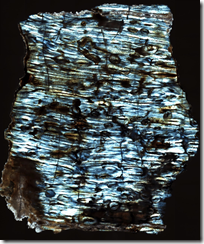
Skull of Paleolophus yunnanensis. (Image by Prof. ZHU Min’s team)
<関連情報>
- https://english.cas.cn/newsroom/research_news/life/202512/t20251215_1137052.shtml
- https://www.cell.com/current-biology/abstract/S0960-9822(25)01539-8
新しい化石魚が初期の肺魚の急速な進化を明らかにする A new fossil fish sheds light on the rapid evolution of early lungfishes
Tuo Qiao ∙ Xindong Cui ∙ Wenjin Zhao ∙ … ∙ Jing Lu ∙ Brian Choo ∙ Min Zhu
Current Biology Published:December 10, 2025
DOI:https://doi.org/10.1016/j.cub.2025.11.032
Highlights
- New Pragian fossil from China reveals early lungfish anatomy
- Lungfish key feeding traits evolved rapidly within ∼4 million years
- Cranial specialization for durophagy drove early lungfish diversification
- Analysis suggests Early Devonian biogeographic link between China and North America
Summary
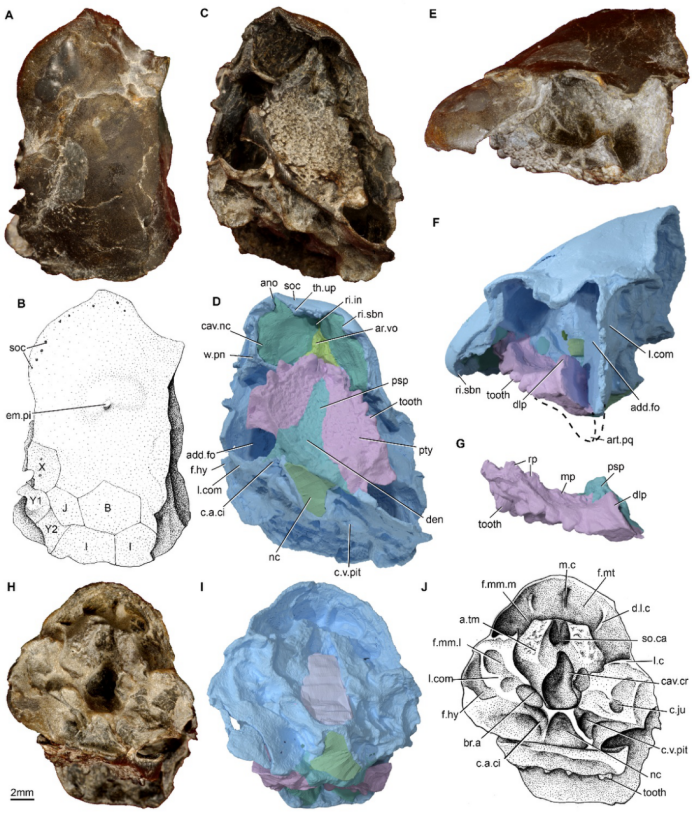
Lungfishes, the closest living relatives of land vertebrates, have a long and conservative evolutionary history that began over 415 million years ago (mya) in the Early Devonian.1,2,3 Morphological gaps between the earliest known and most primitive lungfish, Diabolepis, and the more derived members of the group (Eudipnoi) hinder a comprehensive understanding of key evolutionary transformations near the onset of this lineage.1 A few early eudipnoans from the Pragian (∼410 Ma),4,5,6,7 such as Uranolophus from Wyoming, USA,8,9 have been thought to fill this gap, but their fossils are too flattened to reveal internal structures like the braincase.8,9,10,11 Here, we describe a new eudipnoan from the Pragian of China, whose skull is exceptionally well preserved, allowing us to study the inside of the head in detail for the first time in such an early lungfish. The new species has a palate similar to Uranolophus but also retains several features seen in Diabolepis. Phylogenetic and tip-dating Bayesian analyses place it at the base of the eudipnoan lineage, suggesting that lungfishes evolved rapidly during their early history. The discovery also points to connections between South China and North America during the Early Devonian. Altogether, this find helps clarify how early lungfishes developed key features that later shaped the group known today as the “living fossils.”12,13,14