2025-12-17 ジョンズ・ホプキンス大学(JHU)
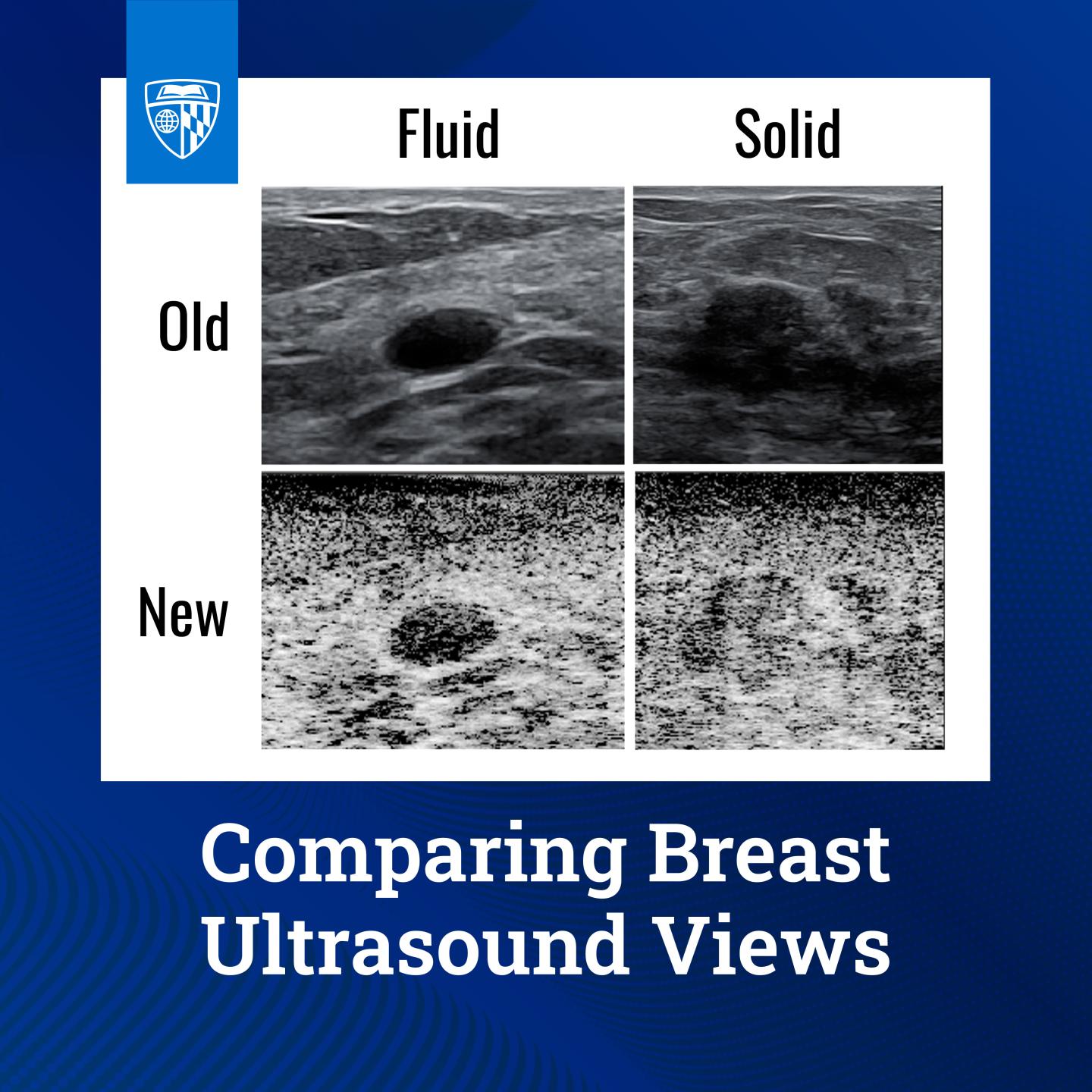
Conventional ultrasound of breast tissue compared to the new method.Image credit: Johns Hopkins University
<関連情報>
- https://hub.jhu.edu/2025/12/17/new-tech-reduces-false-positives-from-breast-ultrasounds/
- https://academic.oup.com/radadv/article/2/6/umaf037/8300868
短遅延空間コヒーレンス超音波に一般化コントラスト対ノイズ比を適用することで、乳腺嚢胞と固形腫瘤を区別できる Generalized contrast-to-noise ratio applied to short-lag spatial coherence ultrasound differentiates breast cysts from solid masses
Arunima Sharma, PhD;Eniola T Oluyemi, MD, MPH;Madhavi Tripathi, PhD;Emily B Ambinder, MD, MS;Lisa A Mullen, MD;Babita Panigrahi, MD;Joanna Rossi, MD, MPH;Nethra Venkatayogi, BS;Kelly S Myers, MD;Muyinatu A Lediju Bell, PhD
Radiology Advances Published:24 October 2025
DOI:https://doi.org/10.1093/radadv/umaf037
Abstract
Background
Benefits of ultrasound in breast cancer detection are often limited by the similar appearance of complicated cysts and solid hypoechoic masses with B-mode imaging, which can lead to false positive diagnoses.
Purpose
To evaluate the diagnostic performance of generalized contrast-to-noise ratio (gCNR) on short-lag spatial coherence (SLSC) ultrasound images as an objective tool to improve complicated cyst vs solid mass classification.
Materials and Methods
For this secondary analysis of a prospective recruitment for the Advanced Ultrasound Signal Processing of Suspicious Breast Images (AUSPICIOUS) observational study (NCT07206888), women scheduled for ultrasound-guided procedures or follow-up of at least 1 breast mass were enrolled from March 2018 to October 2023. Raw ultrasound data were acquired with an Alpinion ECUBE12R research scanner, then post-processed with our custom software. The primary evaluation indicator was gCNR applied to SLSC images with regions of interest determined by 6 radiologists. Outcomes were compared to the same radiologists classifying mass contents as solid, fluid, mixed, or uncertain using B-mode images. The reference standard was determined by aspiration, pathology, or characterization of image features. Areas under receiver operating characteristic curves (AUCs) with 95% confidence intervals (CIs) and inter-reader agreement (Fleiss’ κ) were assessed.
Results
Among 175 cases, 145 breast masses from 115 women (age: 52 ± 17 years) were analyzed, including 16 complicated cysts and 96 solid masses. The mean AUC for complicated cyst vs solid mass characterization was 0.96 (95% CI: 0.94, 0.97) with gCNR applied to SLSC images, relative to a mean lower-bound AUC of 0.67 (range: 0.54-0.76) with readings of B-mode images (P < .05). Inter-reader agreement improved from fair with B-mode (κ = 0.40) to moderate with gCNR applied to SLSC images with a 0.76 threshold (κ = 0.59, P < .00001).
Conclusion
Applying an objective gCNR metric to SLSC images improved the differentiation of complicated cysts from solid masses when compared to subjective readings of B-mode images.