2025-12-22 ロードアイランド大学(URI)
<関連情報>
- https://www.uri.edu/news/2025/12/uri-researchers-uncover-molecular-mechanisms-behind-speciation-in-corals/
- https://www.nature.com/articles/s41467-025-65226-9
サンゴ礁における水深勾配を介した種分化 Speciation across depth gradients in reef corals
Matías Gómez-Corrales,Ana María González Angel,Bishoy Kamel,Mónica Medina,Nancy Knowlton,Don R. Levitan & Carlos Prada
Nature Communications Published:19 November 2025
DOI:https://doi.org/10.1038/s41467-025-65226-9
Abstract
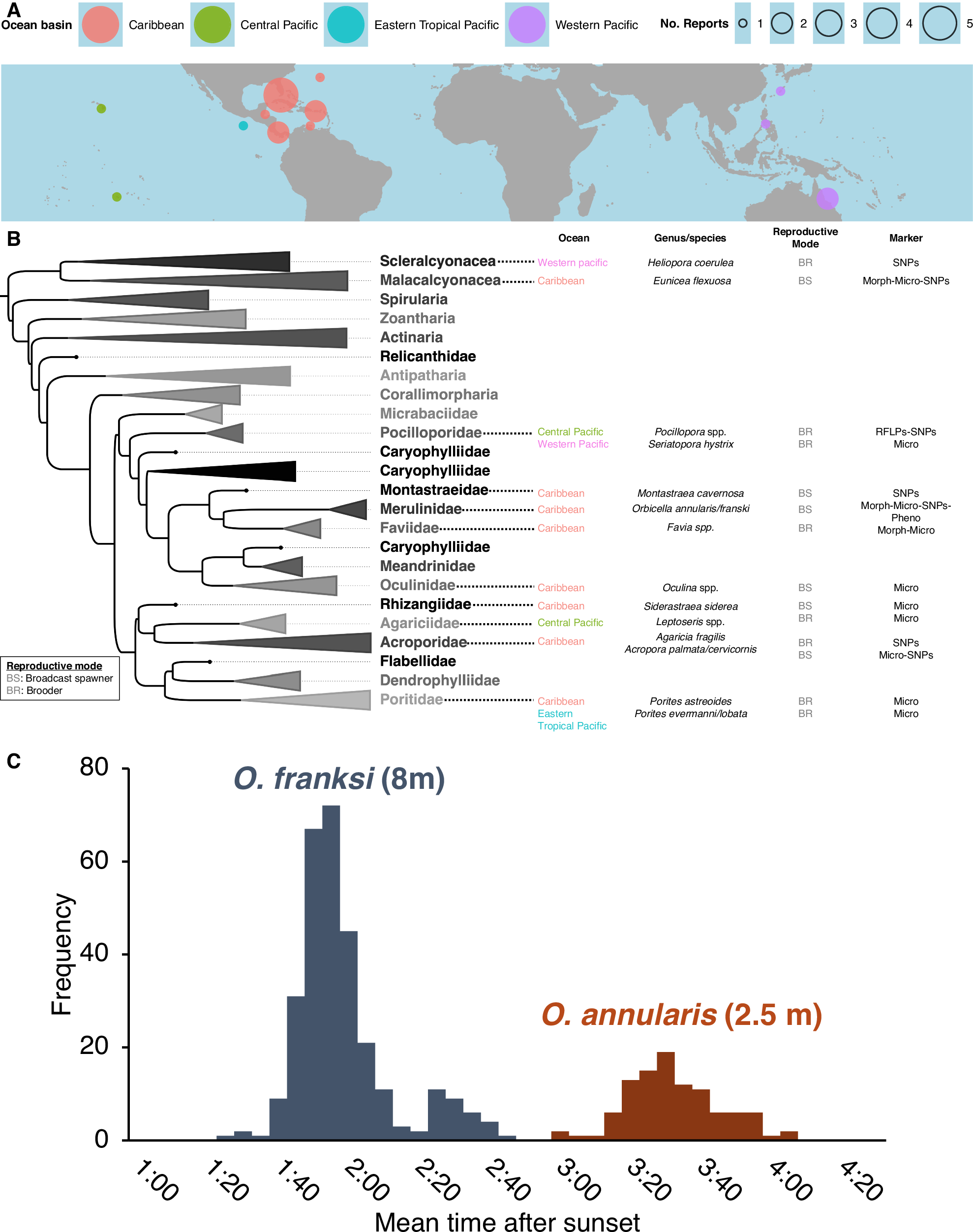
Ecological speciation through adaptation to different habitats can readily occur without strong geographic isolation when the same traits underlie both ecological divergence and reproductive isolation. In light-dependent corals with environment-mediated spawning, adaptation to varying light regimes across depths provides opportunities for such speciation. We show that depth-related distributions are common among sister lineages of corals within the photic zone. We then investigated molecular drivers of depth-associated adaptive divergence by analyzing sequence variation in proteins related to environmental sensing in depth-segregated and light-dependent lineages in the Orbicella species complex. Specifically, we analyzed 1) two genetically divergent ecotypes of Orbicella faveolata across a depth gradient, and 2) two depth-segregated sister species, O. annularis and O. franksi, with different spawning times following sunset. Genome-wide analyses indicate divergence across depths occurred through adaptation via positive selection on G-protein-coupled receptors (GPCRs). These molecules mediate chemo/photo/thermo-reception, enhancing physiological adaptation across environments, and are also involved in reproductive isolation via differences in spawning time. Our study proposes a molecular mechanism for the origin of depth-segregated coral species, common across anthozoans, in which ecological divergence operates at spatial scales smaller than their larval dispersal potential, and highlights avenues contributing to generating biodiversity in the sea.