2025-12-26 京都大学
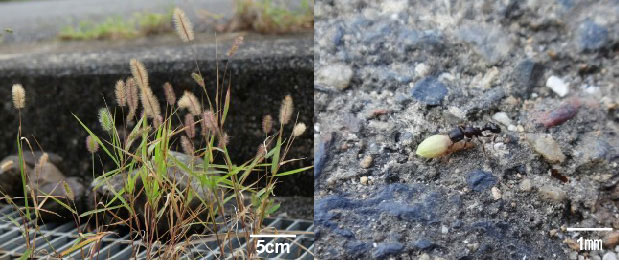
エノコログサ(左)と種子(穎果)を加えて運ぶトビイロシワアリ(右)
<関連情報>
- https://www.kyoto-u.ac.jp/ja/research-news/2025-12-26-1
- https://www.kyoto-u.ac.jp/sites/default/files/2025-12/web_2512_Yamao-f940def19bc565d35ee06d968381cdaa.pdf
- https://esj-journals.onlinelibrary.wiley.com/doi/10.1111/1442-1984.70040
イネ科植物におけるアリ散布:エノコログサ(Setaria viridis)とアキノエノコログサ(Setaria faberi)におけるアリ散布の実証Ant-mediated seed dispersal in the Poaceae: Evidence of myrmecochory in green foxtail (Setaria viridis) and giant foxtail (Setaria faberi)
Ayaka Kimura, Haruna Ohsaki, Takuto Kaneko, Akira Yamawo
Plant Species Biology Published: 16 December 2025
DOI:https://doi.org/10.1111/1442-1984.70040
Abstract
Ant-mediated seed dispersal is an expression of mutualism between plants and insects that may drive the diversification of flowering plants. However, despite its ecological and evolutionary importance, research on myrmecochory has lacked a tractable model system. Here, we studied seed dispersal in Setaria viridis and Setaria faberi (Poaceae) by ants. In field investigations, the caryopses of S. viridis and S. faberi were transported by Tetramorium tsushimae or Formica japonica workers. In the laboratory, T. tsushimae only removed the pericarp of S. viridis, leaving the rest of the seed intact, suggesting that the pericarp of S. viridis functions as an elaiosome. In contrast, T. tsushimae left the pericarp of all S. faberi seeds untouched. The presence of lipids in the pericarp of S. viridis and S. faberi was confirmed by Sudan IV staining. Overall, our findings provide the first experimental evidence of ant-mediated seed dispersal in S. viridis and S. faberi, demonstrating the occurrence of myrmecochory in the Poaceae. Because S. viridis offers rich genomic resources and is experimentally tractable, it has strong potential as a new model system.