
2025-12-29 フランス国立科学研究センター(CNRS)
<関連情報>
- https://www.cnrs.fr/en/press/discovery-essential-sleep-rhythm-appeared-300-million-years-ago
- https://www.nature.com/articles/s41593-025-02159-y
睡眠依存の低周波リズムは爬虫類と哺乳類で進化的に保存されている Sleep-dependent infraslow rhythms are evolutionarily conserved across reptiles and mammals
Antoine Bergel,Julien M. Schmidt,Baptiste Barrillot,Sébastien Arthaud,Laetitia Averty,Mark S. Blumberg,Camille Carachet,Angeline Clair,Irina Filchenko,Chloé Froidevaux,Anthony Herrel,Bertrand Massot,Niels C. Rattenborg,Markus H. Schmidt,Mickael Tanter,Gianina Ungurean & Paul-Antoine Libourel
Nature Neuroscience Published:29 December 2025
DOI:https://doi.org/10.1038/s41593-025-02159-y
Abstract
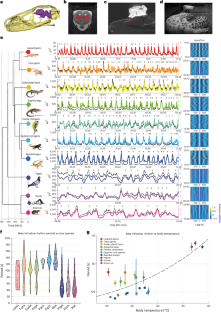
By recording brain activity in seven lizard species, humans, rats and pigeons, we demonstrate an infraslow brain rhythm during sleep in all species. This rhythm is tightly coupled with eye movements, muscle tone, heart and breathing rate in lizards, with skin brightness in chameleons and with pulsatile changes in cerebrovascular volume throughout sleep in bearded dragons and during non-rapid eye movement sleep in mice. These findings indicate that the infraslow rhythm is conserved across amniotes, questioning the evolution of sleep states.

