2026-01-06 中国科学院(CAS)
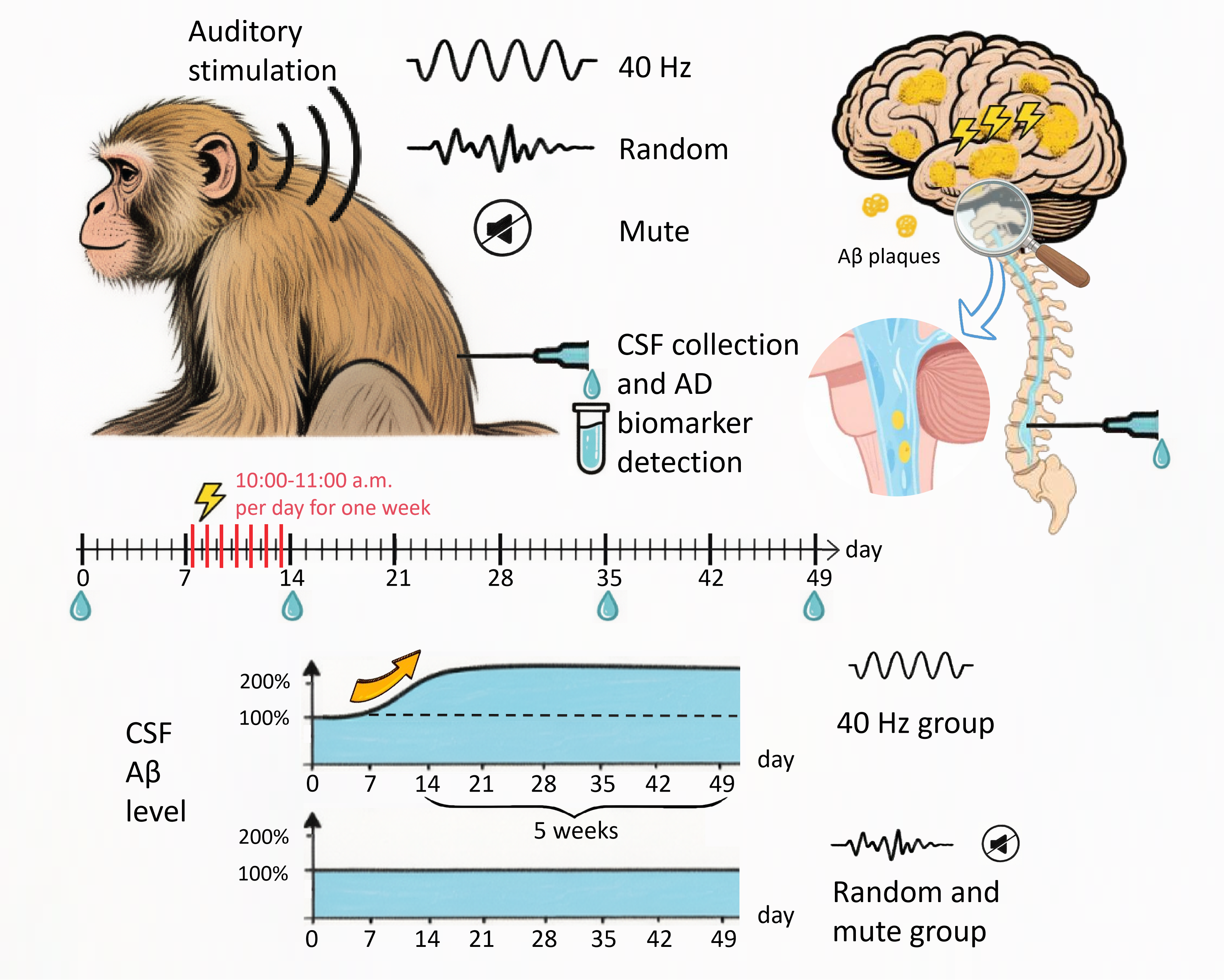
40Hz auditory stimulation specifically caused a significant increase of over 200% in Aβ42 and Aβ40 protein levels in the CSF of aged monkeys, which persisted for more than 5 weeks. (Image by KIZ)
<関連情報>
- https://english.cas.cn/newsroom/research-news/202602/t20260210_1150314.shtml
- https://www.pnas.org/doi/10.1073/pnas.2529565123
アルツハイマー病治療における40ヘルツ聴覚刺激の長期的影響:老齢サルモデル研究からの知見 Long-term effects of forty-hertz auditory stimulation as a treatment of Alzheimer’s disease: Insights from an aged monkey model study
Wenchao Wang, Rongyao Huang, Longbao Lv, +9 , and Xintian Hu
Proceedings of the National Academy of Sciences Published:January 5, 2026
DOI:https://doi.org/10.1073/pnas.2529565123
Significance
Although 40-Hz physical stimulation shows therapeutic potential for Alzheimer’s disease (AD) in rodents, translational validation in nonhuman primates is critical. We applied 40-Hz auditory stimulation on nine aged rhesus monkeys and monitored their cerebrospinal fluid (CSF) Aβ and Tau level changes as indices of the treatment effect. Seven days’ stimulation triggered a rapid CSF Aβ increase by more than 200%. In addition, the Aβ elevation persisted for over five weeks after treatment cessation-unreported in any rodent studies. Postmortem analysis of four of the experimental monkeys revealed widespread Aβ plaques in the brains. This study provides the first primate evidence of 40-Hz auditory stimulation can sustainably modulate the Aβ metabolism in the brain, supporting its potential as a noninvasive AD treatment method.
Abstract
Based mainly on rodents studies, forty-hertz (40-Hz) physical stimulation has been regarded as a potential noninvasive treatment for Alzheimer’s disease (AD). Considering the brain differences between rodents and humans, the effects of 40-Hz physical stimulation need to be further validated using nonhuman primates before its clinical application. Here, we took advantage of a rare opportunity to expose nine aged rhesus monkeys (26 to 31 y old) to 40-Hz auditory stimulation. Given the strong correlation between cerebrospinal fluid (CSF) Aβ and Tau concentrations and corresponding AD pathology in brain parenchyma in clinical practice, we investigated the effects of 40-Hz stimulation on AD pathology by monitoring changes in CSF Aβ and Tau concentrations. Our results revealed that 7 consecutive days of 40-Hz auditory stimulation triggered a rapid and significant increase of Aβ levels by more than 200%, but no effect on Tau levels in the CSF. Additionally, we observed that the elevation of CSF Aβ levels persisted for more than 5 wk after cessation, which had not been reported in any previous studies. After this, a pathological examination of the temporal cortices of 4 of the experimental monkeys was carried out and the data demonstrated that all of them had prevalent extracellular Aβ senile plaque pathology, whereas Tau pathology was negative or very weak. These results provide a good explanation for the differences between the CSF Aβ and Tau protein levels. Together, these first-time results from monkeys suggest that 40-Hz auditory stimulation has strong potential of a noninvasive AD treatment method.