2026-01-08 国立遺伝学研究所
IPTG を用いた遺伝子発現誘導法
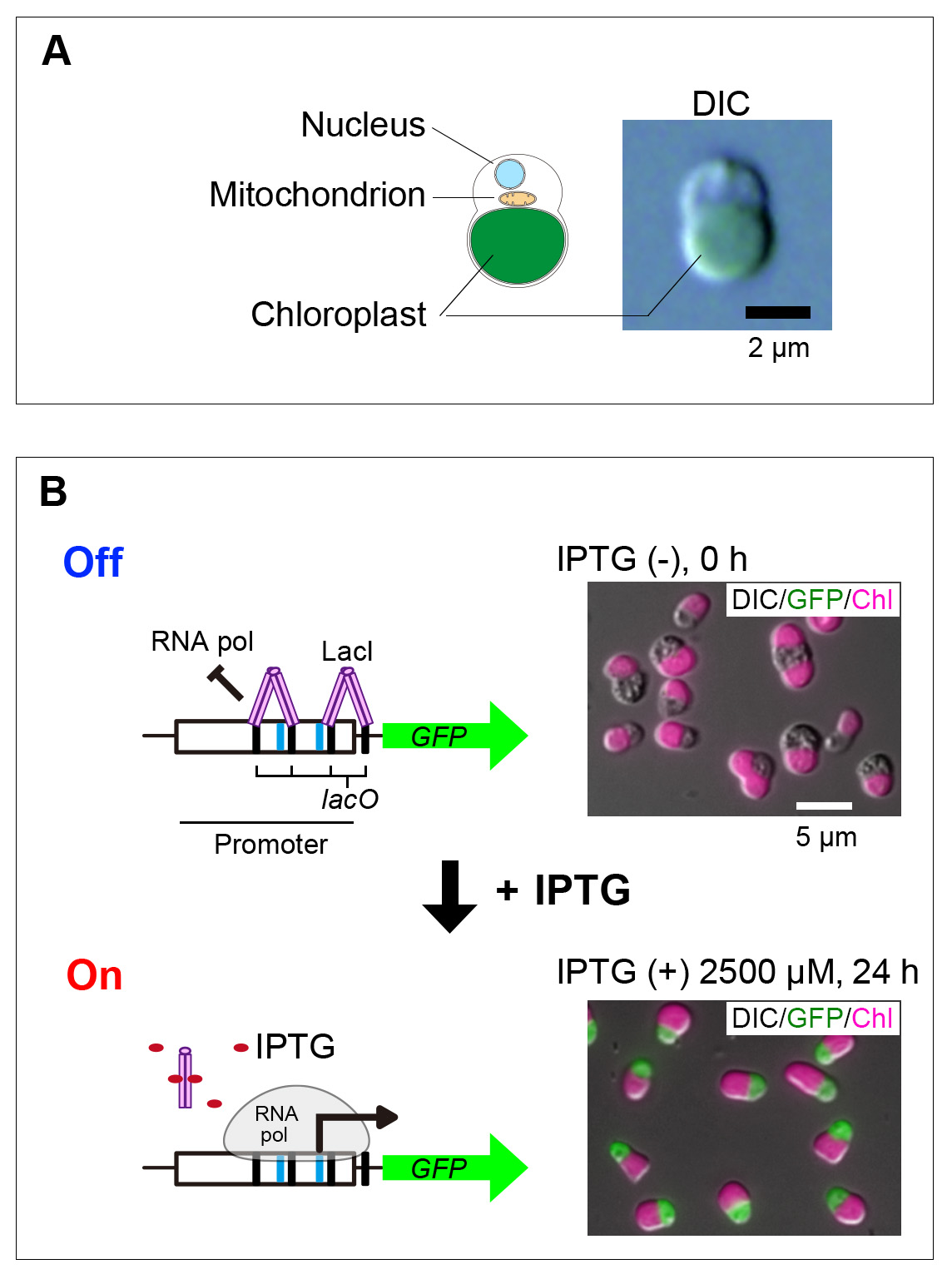
(A) 微細藻類の1種である単細胞紅藻 Cyanidioschyzon merolae の細胞構造の模式図と、微分干渉顕微鏡(DIC)像。
(B) IPTG 誘導型遺伝子発現系の模式図と、レポータータンパク質 GFP(緑)を IPTG 依存的に発現した細胞の蛍光顕微鏡像。プロモーター領域内に lac オペレーター配列(lacO)を 4 か所配置した。別途発現させた大腸菌由来の LacI リプレッサーがこれらに結合することで転写が抑制される。IPTG を添加すると LacI がlacO から解離し、転写が開始される。IPTG 添加後 4 時間以降に GFP タンパク質の発現が確認された。DIC像は細胞の輪郭を示す。GFP(緑)は細胞質に局在する蛍光シグナルを、Chl(マゼンタ)は葉緑体の光合成色素による蛍光を示す。スケールバーは図中に示す。
<関連情報>
- https://www.nig.ac.jp/nig/ja/2026/01/research-highlights_ja/rh20260108.html
- https://academic.oup.com/plphys/article/200/1/kiaf575/8320112?login=false
単細胞紅藻Cyanidioschyzon merolaeにおけるIPTGおよびエストラジオール誘導性遺伝子発現システム IPTG- and estradiol-inducible gene expression systems in the unicellular red alga Cyanidioschyzon merolae
Takayuki Fujiwara ,Shunsuke Hirooka ,Shota Yamashita ,Shin-ya Miyagishima
Plant Physiology Published:10 November 2025
DOI:https://doi.org/10.1093/plphys/kiaf575
Abstract
The genetically tractable unicellular red alga Cyanidioschyzon merolae has a remarkably simple genome (4,775 nucleus-encoded proteins) and cellular architecture. It contains only a single set of most membranous organelles, making it a valuable tool for elucidating the fundamental mechanisms of photosynthetic eukaryotes. However, as in other genetically tractable eukaryotic algae, previously developed systems for inducible gene expression rely on environmental stimuli such as heat shock or ammonium depletion, which impact cellular physiology and thus limit their usage. To overcome this issue, we developed IPTG- and estradiol-inducible gene expression systems in C. merolae in which the addition of these chemicals itself has no impact on cellular growth or the transcriptome. Additionally, we established IPTG- and estradiol-inducible protein knockdown systems and successfully degraded the endogenous chloroplast division protein DRP5B using the estradiol-inducible system. These systems facilitate functional genomic analyses in C. merolae, especially for understanding physiological mechanisms and their interactions in photosynthetic eukaryotes.