2026-01-08 東京大学
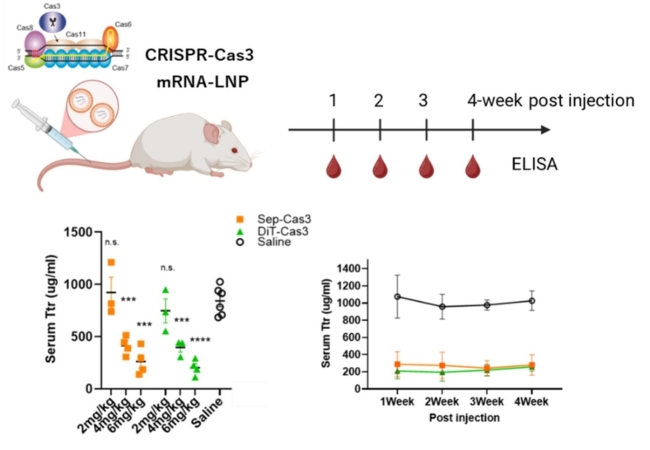
CRISPR-Cas3 mRNA-LNPによるマウスin vivoゲノム編集
<関連情報>
- https://www.ims.u-tokyo.ac.jp/imsut/jp/about/press/page_00367.html
- https://www.ims.u-tokyo.ac.jp/imsut/content/000012151.pdf
- https://www.nature.com/articles/s41587-025-02949-6
トランスサイレチンアミロイドーシスのマウスモデルにおける標的欠失のためのCRISPR-Cas3ベースの編集 CRISPR–Cas3-based editing for targeted deletions in a mouse model of transthyretin amyloidosis
Saeko Ishida,Yusuke Sato,Keisuke Chosa,Eri Ezawa,Yuko Yamauchi,Masaaki Oyama,Hiroko Kozuka-Hata,Rina Ito,Rikako Sato,Masatoshi Maeki,Tomo-o Ishikawa,Kenichi Yamamura,Kohei Takeshita,Kensuke Yamaguchi,Yuta Kochi,Fumitaka Hashiya,Yiwei Liu,Naoko Abe,Hiroshi Abe,Yoshiki Sekijima,Kazuto Yoshimi & Tomoji Mashimo
Nature Biotechnology Published:05 January 2026
DOI:https://doi.org/10.1038/s41587-025-02949-6
Abstract
CRISPR–Cas3 represents a mechanistically distinct genome-editing system compared to Cas9 that generates long-range deletions rather than small indels, thereby reducing the risk of residual protein function from in-frame mutations. Here we evaluated CRISPR–Cas3 to correct mutations in the TTR gene causing transthyretin amyloidosis, a systemic proteinopathy where loss of mutant TTR in the liver offers therapeutic benefit. Through CRISPR RNA optimization we achieved 58.9% ± 0.5% editing at the TTR locus in vitro, inducing large deletions that abolished TTR expression. Cas3 generated mostly directional deletions up to 75 kb without reproducible off-target mutations, in contrast to Cas9, which induced indels at several off-target sites. In vivo, a single lipid-nanoparticle-based treatment achieved 48.7% ± 1.1% hepatic editing and reduced serum TTR levels by 80.1% ± 4.6%. Deletion size was limited to 21 kb. In TTR exon-humanized mice, Cas3 editing reduced serum TTR without in-frame mutations and attenuated macrophage-associated TTR deposition. These findings highlight Cas3 as an efficient and distinct sytem for in vivo genome editing.