2026-01-08 マックス・プランク研究所
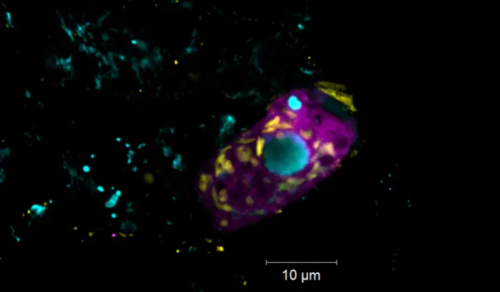
The endosymbiont Candidatus Azoamicus mariagerensis and its ciliate host under the fluorescence microscope. Visible is the endosymbiont (stained yellow), and the ciliate host (stained purple). The ciliate nucleus is stained with a DNA stain (in blue).© MPI f. Marine Microbiology/ Linus Matz Zeller
<関連情報>
- https://www.mpg.de/25974903/0108-mbio-unseen-allies-symbiotic-bacteria-help-clean-wastewater-but-there-is-a-catch-154772-x
- https://academic.oup.com/ismecommun/article/5/1/ycaf209/8324244
廃水微生物叢における脱窒性原生生物共生菌の出現と時間的ダイナミクス Occurrence and temporal dynamics of denitrifying protist endosymbionts in the wastewater microbiome
Louison Nicolas-Asselineau,Daan R Speth,Linus M Zeller,Ben J Woodcroft,Caitlin M Singleton,Lei Liu,Morten K D Dueholm,Jana Milucka
ISME Communications Published:15 November 2025
DOI:https://doi.org/10.1093/ismeco/ycaf209
Abstract
Effective wastewater treatment is of critical importance for preserving public health and protecting natural environments. Key processes in wastewater treatment, such as denitrification, are performed by a diverse community of prokaryotic and eukaryotic microbes. However, the diversity of the microbiome and the potential role of the different microbial taxa in some wastewater treatment plant setups is not fully understood. We aimed to investigate the presence and diversity of denitrifying bacteria of the candidate family Azoamicaceae that form obligate symbioses with protists in wastewater treatment plants. Our analyses showed that denitrifying endosymbionts belonging to the Ca. Azoamicus genus are present in 20%–50% of wastewater treatment plants worldwide. Time-resolved amplicon data from four Danish WWTPs showed high temporal fluctuations in the abundance and composition of the denitrifying endosymbiont community. Twelve high-quality metagenome-assembled genomes of denitrifying endosymbionts, four of which were circular, were recovered. Genome annotation showed that a newly described, globally widespread species, Ca. Azoamicus parvus, lacked a nitrous oxide reductase, suggesting that its denitrification pathway is incomplete. This observation further expands the diversity of metabolic potentials found in denitrifying endosymbionts and indicates a possible involvement of microbial eukaryote holobionts in wastewater ecosystem dynamics of nitrogen removal and greenhouse gas production.