2026-01-21 カリフォルニア大学サンディエゴ校(UCSD)
<関連情報>
- https://today.ucsd.edu/story/positive-interactions-dominate-among-marine-microbes-six-year-study-reveals
- https://academic.oup.com/ismej/article/20/1/wraf287/8407146
温度は海洋微生物叢における相互作用とキーストーン分類群を変化させる Temperature alters interactions and keystone taxa in the marine microbiome
Ewa Merz ,Riley J Hale ,Erik Saberski ,Kasia M Kenitz ,Melissa L Carter ,Jeff S Bowman ,Andrew D Barton
The ISME Journal Published:21 January 2026
DOI:https://doi.org/10.1093/ismejo/wraf287
Abstract
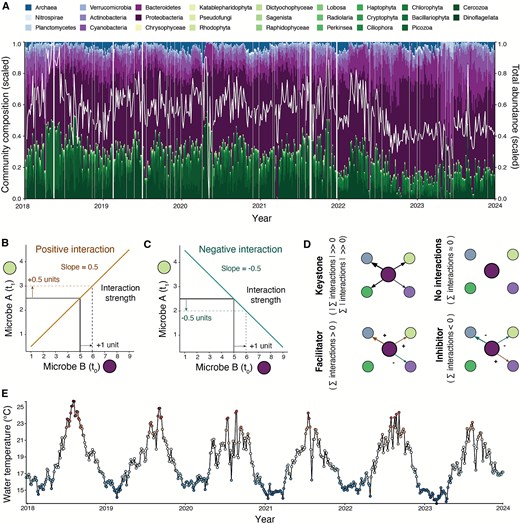
Marine microbes shape global biogeochemical cycles and marine food webs. Although biotic interactions underpin microbial community dynamics, most interactions between wild marine microbes are unknown. Here, we used empirical dynamic modeling to examine a six-year record of coastal microbial community composition to quantify microbial interactions and their changes through time. We found that, on average, marine microbes interact with 20% of other taxa in the community, most interactions are weak (80%), and that positive interactions are more common than negative interactions. Keystone taxa, defined as having disproportionally strong and frequent interactions, were not generally the most abundant taxa. The strength and sign of interactions, as well as the identity of the keystone taxa, varied through time and with changes in water temperature. An increase of 13°C, the dynamic range in water temperature at this location during the observational period, led to a 33% less interactive microbial community and an 11% shift towards more positive interactions. Only a few of the keystone taxa are the most interactive in the community at all times, and we found a temporal succession of keystone taxa. These results reveal that interactions in the marine microbiome are common, more facilitative than previously thought, and highly variable through time.