2026-01-22 中国科学院(CAS)
<関連情報>
- https://english.cas.cn/newsroom/research-news/202602/t20260210_1150352.shtml
- https://www.nature.com/articles/s41556-025-01855-y
DNAナノデバイスはリソソーム表面の酸性ナノ層を検出する DNA nanodevices detect an acidic nanolayer on the lysosomal surface
Yutong Zhang,Meiqin Hu,Yaping Meng,Xin Wang,Fangqian Huang,Ping Li,Yuting Zhuo,Danzhen Chen,Zhimin Wang,Qiang Zhang,Hui Wu,Yao He,Yulin Du,Haoxing Xu,Liping Qiu & Weihong Tan
Nature Cell Biology Published:21 January 2026
DOI:https://doi.org/10.1038/s41556-025-01855-y
Abstract
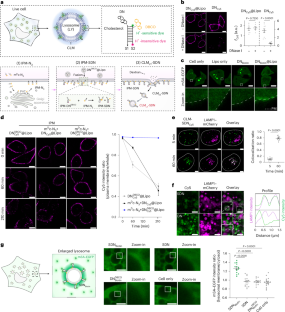
Lysosomes maintain a highly acidic lumen to regulate H+-dependent hydrolase-mediated degradation, but how protons are ‘leaked’ out to regulate organellar functions through cytosolic effectors remains unknown. Here we developed DNA nanodevices on the cytosolic leaflet of lysosomal membranes to monitor juxta-organellar pH in cells. Unexpectedly, we revealed a radiating acidic layer (up to 21 nm in thickness) on the outer surface of all lysosomes, typically 0.2–0.7 pH units more acidic than the neutral cytosol. This acidic nanolayer is established and maintained primarily by TMEM175, a lysosomal H+ efflux channel associated with Parkinson’s disease. Activation of TMEM175 causes opposite pH changes on both sides of lysosomes; however, it is the juxta-lysosomal, not the luminal, acidity that determines lysosome positioning in cells with dynein adaptor RILP acting as a juxta-lysosomal pH sensor. Hence, through inside-out proton conduits, lysosomes create a steady acidic surrounding that acts as a nano-interface for cytosolic machineries to regulate organellar activities.