
2026-01-28 青森県立保健大学
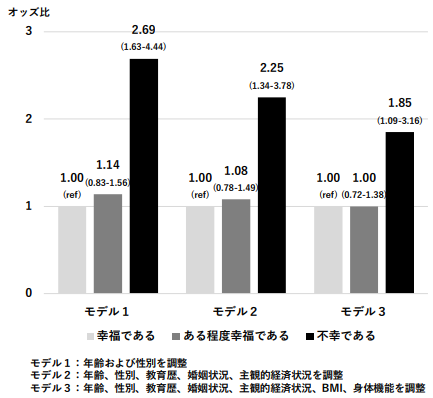
図 日本の成人における幸福感と全死因死亡率の関連
<関連情報>
- https://www.auhw.ac.jp/news/press/2026-0127-0906-239.html
- https://www.auhw.ac.jp/news/press/files/20260128_AUHWpressrelease.pdf
- https://psycnet.apa.org/fulltext/2027-16336-001.html
国家幸福度と死亡率の関連性:日本における前向きコホート研究からのエビデンス Association of State Happiness With Mortality: Evidence From a Prospective Cohort Study in Japan
Akitomo Yasunaga, Ai Shibata, Yoshino Hosokawa, Mohammad Javad Koohsari, Rina Miyawaki, Kuniko Araki, Kaori Ishii, Koichiro Oka
Health Psychology Published:January 19, 2026
DOI:https://doi.org/10.1037/hea0001571
Abstract
Objective: The aim of this study was to examine whether the association between happiness and all-cause mortality persists after adjustment for health status and sociodemographic factors in Japanese adults. The study addressed the gap in understanding the relationship between happiness and mortality in Japanese populations.
Method: A total of 3,187 adults from Minami-Izu, Japan, were included in a prospective study tracking all-cause mortality from October 2016 to October 2023. Happiness was assessed using a single-item, self-report measure of state emotional well-being. Sociodemographic factors (age, sex, marital status, education, and economic status) and health status (body mass index and physical function) were considered as covariates. Binary logistic regression models were used to examine the association between happiness and mortality, adjusted for these factors.
Results: During the follow-up, 277 participants died. The risk of all-cause mortality was higher in those who reported being unhappy compared with those who reported being happy after adjustment for age and sex (OR: 2.69, 95% CI: 1.63–4.44) and also significantly higher in those who reported being unhappy compared with those who reported being happy after adjustment for age, sex, all socioeconomic factors and health status (OR: 1.85, 95% CI: 1.09–3.16). Sensitivity analyses excluding deaths within the first year showed consistent results. Conclusions: Happiness is independently associated with reduced mortality risk, even after adjustment for sociodemographic and health status factors. These findings highlight the importance of promoting positive well-being in Japanese populations.
Public Significance Statement
This study found that greater happiness was associated with a lower risk of mortality among Japanese adults. The association remained after accounting for demographic, socioeconomic, and health-related factors. These findings suggest that positive emotional well-being may be a meaningful indicator of long-term health and could inform future public health research and practice.

