2026-01-29 コペンハーゲン大学(UCPH)
<関連情報>
- https://news.ku.dk/all_news/2026/01/new-research-in-mice-sheds-light-on-how-the-brain-understands-what-is-important–and-what-isnt/
- https://www.nature.com/articles/s41586-025-09902-2
学習した手がかりの前頭前野の神経構造が動機づけられた行動を導く Prefrontal neural geometry of learned cues guides motivated behaviours
Nanci Winke,Andreas Lüthi,Cyril Herry & Daniel Jercog
Nature Published:07 January 2026
DOI:https://doi.org/10.1038/s41586-025-09902-2
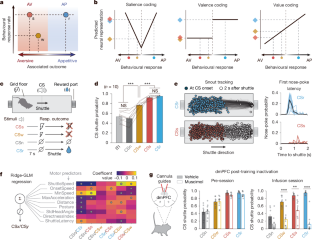
Abstract
Animals continuously evaluate their surroundings to decide whether to approach rewarding opportunities or avoid potential threats. Assigning the appropriate importance to environmental stimuli is not only crucial for survival but also underlies complex forms of goal-directed behaviour that are shared across species, including humans1,2,3,4. Understanding how the brain translates such sensory cues into motivated behaviours is, therefore, central to neuroscience and psychology. The dorsomedial prefrontal cortex (dmPFC) is a critical structure that bridges relevant environmental stimuli to goal-directed behaviour. Salience, valence and value are key dimensions defining stimulus relevance, but how the dmPFC processes and organizes such dimensions to drive motivated behaviour remains unclear. Here we monitored single-neuron populations in the dmPFC using calcium imaging in freely moving male mice while discriminating between stimuli predicting different reward or punishment outcomes, which enabled an unprecedented dissociation of salience, valence and value information. We found that dmPFC populations primarily encode appetitive and aversive values of learned stimuli and that subpopulations encode valence and salience along orthogonal information axes. Our results highlight a concurrent multifaceted population coding of value, salience and valence of stimuli during associative learning within dmPFC networks, such that the geometry of dmPFC neuronal representations dynamically shapes appetitive and aversive motivated behaviours.