2026-01-30 京都大学
<関連情報>
- https://www.kyoto-u.ac.jp/ja/research-news/2026-01-30-1
- https://www.kyoto-u.ac.jp/sites/default/files/2026-01/web_2601_Yabe-bd6af3f11b7b635e891bed451b69ceee.pdf
- https://joe.bioscientifica.com/view/journals/joe/268/1/JOE-25-0257.xml
ChREBP欠損はグルコースシグナル伝達を阻害することで糖尿病性サルコペニアを悪化させる:筋萎縮の新しいマウスモデル ChREBP deficiency aggravates diabetic sarcopenia by disrupting glucose signaling: a novel mouse model of muscle atrophy
Toshinori Imaizumi,Katsumi Iizuka,Hiromi Tsuchida,Mayu Sakai,…
Journal of Endocrinology Published:22 Jan 2026
DOI:https://doi.org/10.1530/JOE-25-0257
Abstract/Excerpt
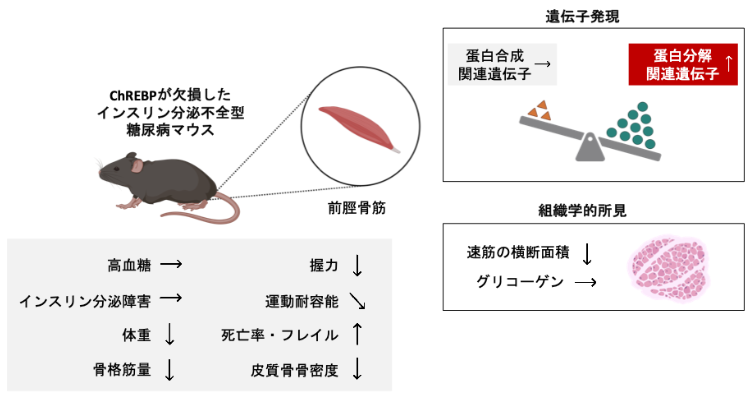
Diabetes is an increasingly prevalent global disease and is often accompanied by sarcopenia, particularly in older adults. While insulin resistance is a well-known contributor to muscle loss in diabetes, the role of glucose signaling in diabetic skeletal muscle atrophy, particularly under insulin-deficient conditions, remains poorly understood. This study aimed to elucidate the pathophysiological role of the carbohydrate-responsive element-binding protein (ChREBP), a glucose-sensing transcription factor encoded by the Chrebp gene in mice, in diabetic sarcopenia by generating Chrebp-deficient, insulin-deficient Ins2Akita/+ mice. We evaluated Chrebp +/+, Chrebp -/-, Ins2Akita/+ /Chrebp +/+, and Ins2Akita/+ /Chrebp -/- mice for muscle strength, endurance, survival, body composition, and muscle histology. Skeletal muscles were analyzed for gene expressions related to anabolic and catabolic pathways. We found that Ins2Akita/+ /Chrebp -/- mice exhibited significant reductions in body weight, grip strength, survival, and skeletal muscle mass – particularly in the tibialis anterior, soleus, gastrocnemius, and quadriceps – compared to Ins2Akita/+ controls, despite similar hyperglycemia. Histological analysis revealed a smaller mean muscle fiber size and reduced cross-sectional area of type 2A and 2B fibers, without changes in fiber-type composition. Furthermore, Igf-1 expression was suppressed, while the atrophy marker Fbxo32/Atrogin-1 was upregulated. These findings demonstrate that Chrebp deletion exacerbates muscle atrophy and frailty in insulin-deficient mice, underscoring a key role for ChREBP-mediated glucose signaling in maintaining muscle mass under diabetic conditions. The Ins2Akita/+ /Chrebp -/- model provides a valuable platform for exploring diabetic sarcopenia mechanisms and potential therapeutic targets.