2026-02-10 中国科学院(CAS)
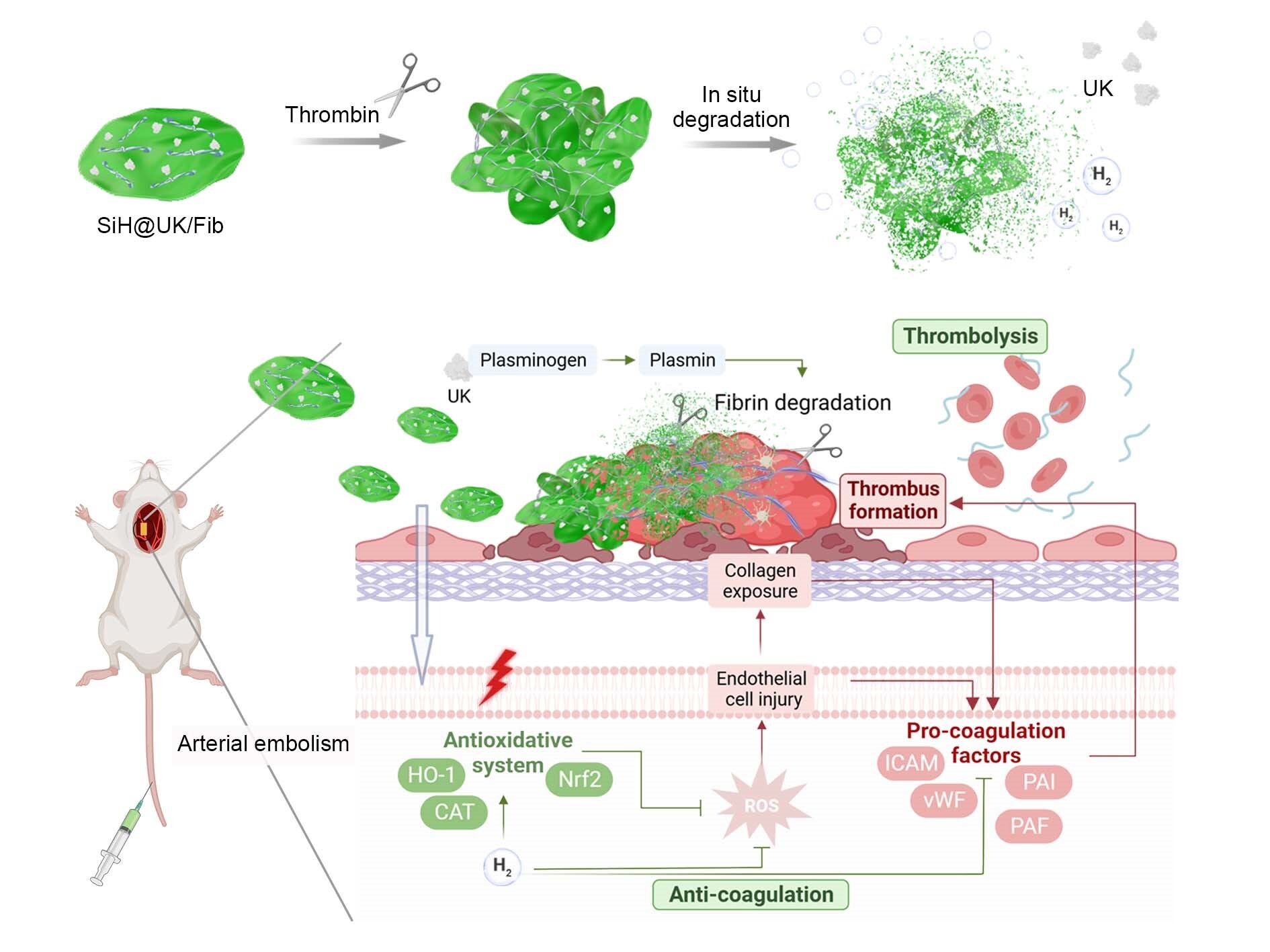
Schematic illustration showing the targeting, anti-coagulation, and thrombolysis mechanisms of the nanothrombolytic (SiH@UK/Fib) against arterial embolism (Image by LIN Han)
<関連情報>
- https://english.cas.cn/newsroom/research-news/202602/t20260213_1150952.shtml
- https://www.science.org/doi/10.1126/sciadv.aea4782
水素化シリコンベースのナノ血栓溶解剤によるin situ凝固環境制御による血栓除去 In situ coagulation environment regulation–assisted thrombus clearance via hydrogenated silicon-based nanothrombolytics
Ya-Xuan Zhu, Zhixin Chen, Yanling You, Yihan Chen, […] , and Jianlin Shi
Science Advances Published:6 Feb 2026
DOI:https://doi.org/10.1126/sciadv.aea4782
Abstract
Thrombotic disorders remain among the leading causes of global mortality, yet current thrombolytic therapies are limited by poor targeting specificity and inadequate microenvironmental modulation, resulting in suboptimal efficacy and serious side effects. Here, we developed a hydrogen-generating nanothrombolytic agent that enables enzymatic clot dissolution in combination with intelligent microenvironment reprogramming. Specifically, we assembled urokinase, a clinical thrombolytic drug, with hydrogenated silicene (SiH) nanosheet and fibrinogen, a substrate of coagulation reaction, to promote thrombolysis. Functionally, SiH nanosheet plays multiple roles in the nanothrombolytics: blocking the functional sites of urokinase to durably inhibit its activity in circulation to prevent systemic bleeding, followed by urokinase reactivation in response to SiH nanosheet self-degradation and prothrombotic microenvironment regulation through the in situ hydrogen generation, which mitigates the oxidative stress of vascular endothelial cells and inhibits their release of procoagulant factors. This microenvironment-adaptive thrombolysis strategy offers a promising paradigm for the precise management of thrombotic emergencies.