2026-02-13 京都大学
<関連情報>
- https://www.kyoto-u.ac.jp/ja/research-news/2026-02-13-4
- https://www.kyoto-u.ac.jp/sites/default/files/2026-02/web_2602_Kanda-6127ff0c7bea23b025af29932475cc09.pdf
- https://www.nature.com/articles/s41598-026-38587-4
急性骨髄性白血病の治療におけるベネトクラックストラフレベルが安全性と有効性に与える影響 Impact of venetoclax trough levels on safety and efficacy in the treatment of acute myeloid leukemia
Hiromi Hayashi,Takeo Yamagiwa,Junya Kanda,Takayuki Ishikawa,Masashi Sawa,Yasuko Miyahara,Takayoshi Tachibana,Mitsumasa Watanabe,Yasunori Ueda,Yasuhiko Tsutsumi,Kazunori Imada,Shin-ichiro Fujiwara,Tomomi Toubai,Kota Yoshifuji,Hirokazu Hirata,Hiroshi Kawabata,Masaaki Tsuji,Satoshi Wakita,Hiroki Yokoyama,Toshiyuki Kitano,Kazunori Murai,Yoshihisa Kataoka,Eri Kawata,Shun-ichi Kimura,… Akifumi Takaori-Kondo
Scientific Reports Published:07 February 2026
DOI:https://doi.org/10.1038/s41598-026-38587-4 An unedited version of this manuscript
Abstract
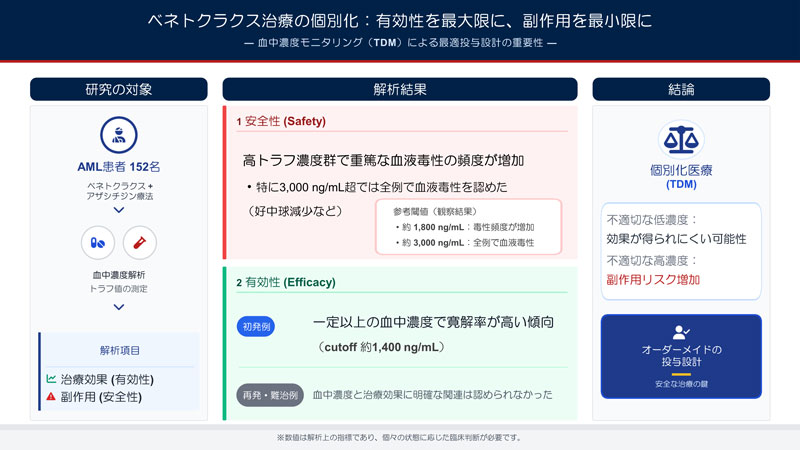
Venetoclax-azacitidine chemotherapy is a key treatment for older or medically unfit patients with acute myeloid leukemia (AML). As venetoclax is metabolized via cytochrome P450 3 A, dose adjustments are required when combined with antifungal agents. However, data on venetoclax concentrations and their impact on safety and efficacy remain limited. This study analyzed the association between venetoclax trough levels and treatment outcomes in 152 AML patients (median age: 70 years). The median trough level was 1,518 ng/mL (range: 60–11,328 ng/mL), with significant interindividual variability, even after adjusting for antifungal use. High venetoclax trough levels were significantly associated with elevated creatinine and total bilirubin levels. Patients with trough levels below 1857.3 ng/mL had lower rates of hematologic toxicity during the first treatment cycle (92.9% vs. 100%, P = 0.041). In the second cycle, hematologic toxicity was lower in patients with concentrations below 1,299.3 ng/mL (68% vs. 90%, P = 0.009). In the treatment-naïve group, trough levels above 1857.3 ng/mL were associated with a higher composite complete remission rate (77.3% vs. 47.8%, P = 0.042). These findings highlight the need for venetoclax dose optimization based on drug levels to improve both safety and efficacy in AML treatment.