2026-02-16 東北大学
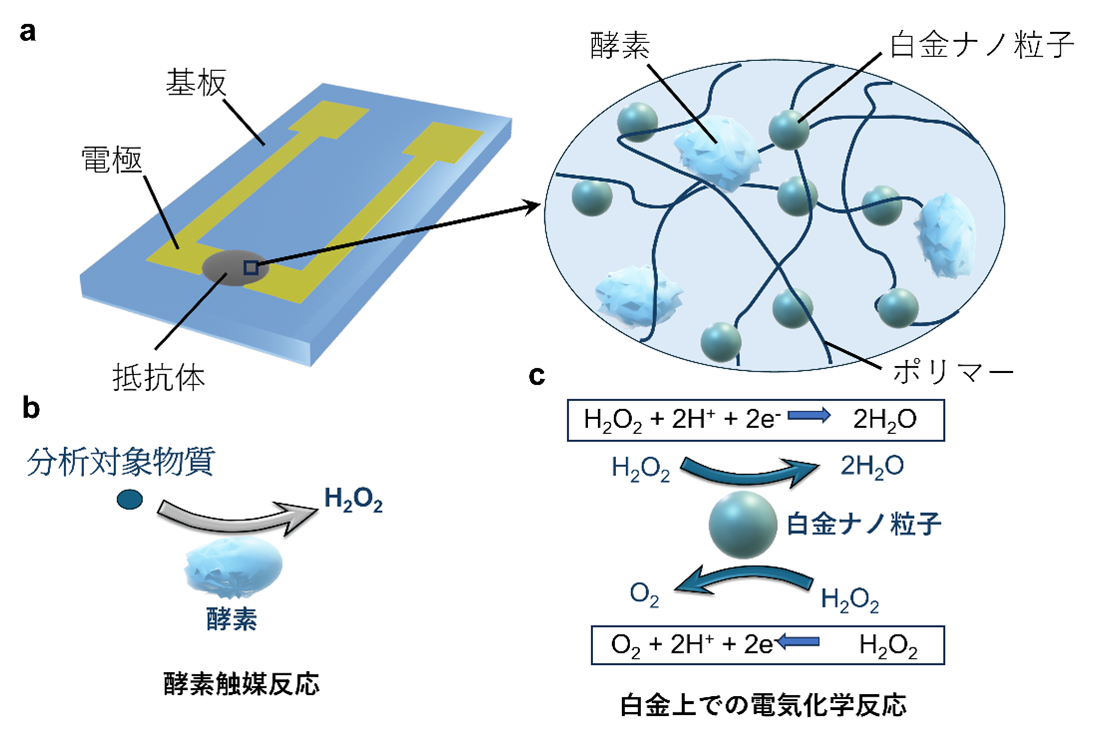
図1. 開発した抵抗型バイオセンサの概要と動作原理。a. センサ構造の模式図。
<関連情報>
- https://www.tohoku.ac.jp/japanese/2026/02/press20260216-02-bio.html
- https://www.tohoku.ac.jp/japanese/newimg/pressimg/tohokuuniv-press20260216_02web_bio.pdf
- https://www.nature.com/articles/s41378-025-01155-3
酵素触媒酸化還元とナノ粒子伝導ネットワークを介して調製された高感度化学抵抗性バイオセンサー High sensitivity chemiresistive biosensor prepared via enzyme-catalyzed redox and nanoparticle conduction network
Yi-Hsiu Kao,Nguyen Van Toan,Takaaki Abe,Ioana Voiculescu & Takahito Ono
Microsystems Nanoengineering Published:13 February 2026
DOI:https://doi.org/10.1038/s41378-025-01155-3
Abstract
The demand is increasing for compact, low-cost biosensors suitable for point-of-care diagnostics. In this study, we developed a novel chemiresistive biosensor based on a platinum (Pt) nanoparticle–polymer composite matrix functionalized with a creatinine enzyme cascade. The sensor detects creatinine through resistance changes triggered by redox reactions of enzymatically generated hydrogen peroxide at the Pt nanoparticle interface. Operating near the percolation threshold of metallic nanoparticles enhances sensor sensitivity, as it promotes the formation of efficient electron conduction paths through hopping and tunneling mechanisms. The simplified two-electrode structure of the device eliminates the need for a reference electrode, enabling miniaturization and facilitating fabrication. Both direct and alternating current measurements confirm that the electrical response arises from interfacial charge redistribution combined with bulk conduction network formation. The biosensor exhibits a wide detection range (1–300 mg/dL), fast response time (~35 s), and strong correlation between analyte concentration and electrical signal. This platform offers a promising approach for high sensitivity, high selectivity, real-time biosensing of creatinine and other biomarkers.