2026-02-17 カリフォルニア大学リバーサイド校(UCR)
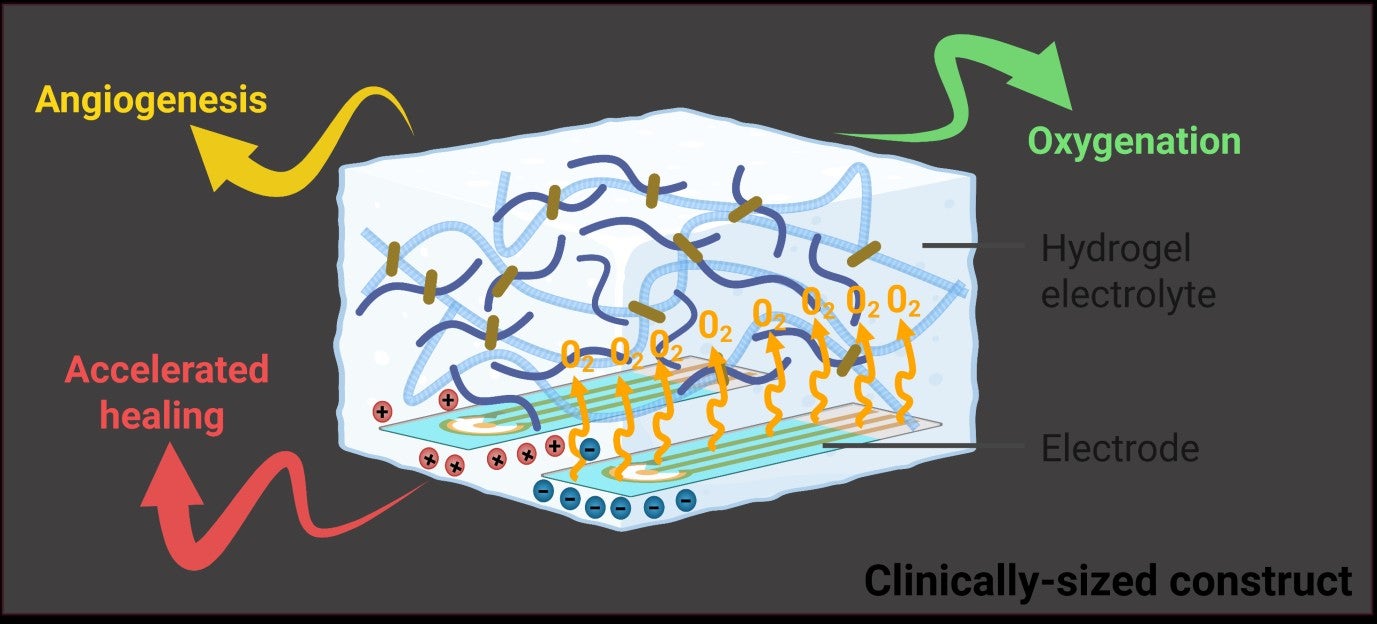
Diagram detailing self-oxygenating gel for wound healing. Electrodes are on the bottom, here. (Iman Noshadi/UCR)
<関連情報>
- https://news.ucr.edu/articles/2026/02/17/gel-wounds-wont-heal
- https://www.nature.com/articles/s43246-025-00947-4
バイオエンジニアリングされた組織構造における局所的かつ持続的な酸素供給のためのスマートな自己酸素化システム A smart self-oxygenating system for localized and sustained oxygen delivery in bioengineered tissue constructs
Vaishali Krishnadoss,Baishali Kanjilal,Aihik Banerjee,Prince David Okoro,Mohammad Khavani,Proma Basu,Nourouddin Sharifi,Johnson V. John,Manuela Martins-Green,Amos Mugweru,Mohammad R. K. Mofrad,Arameh Masoumi & Iman Noshadi
Communications Materials Published:05 January 2026
DOI:https://doi.org/10.1038/s43246-025-00947-4
Abstract
Severe hypoxia within thick bioengineered tissues critically impairs cell viability and function, limiting their application in organ-scale engineering and regenerative medicine. Current methods for oxygen delivery often fall short of providing sustained oxygenation before neovascularization. Here, we introduce a smart self-oxygenating tissue (SSOT) platform that leverages a bio-ionic liquid (BIL)-functionalized biocompatible hydrogel electrolyte for localized and controlled oxygen generation via electrolysis. Comprehensive characterization of the system confirmed stability and electrochemical properties, with molecular dynamics simulations demonstrating that BIL enhances oxygen release. In vitro, the SSOT platform maintains cell viability and promotes vascularization under severe hypoxic conditions. Diabetic wound healing studies using mouse models showed that an SSOT patch accelerates wound closure in chronic and non-chronic wounds. These findings highlight the potential of electrolysis-driven methods for providing on-demand and sustained oxygen delivery, essential for the development of functional living tissues and ultimately organs.