2026-03-02 北海道大学
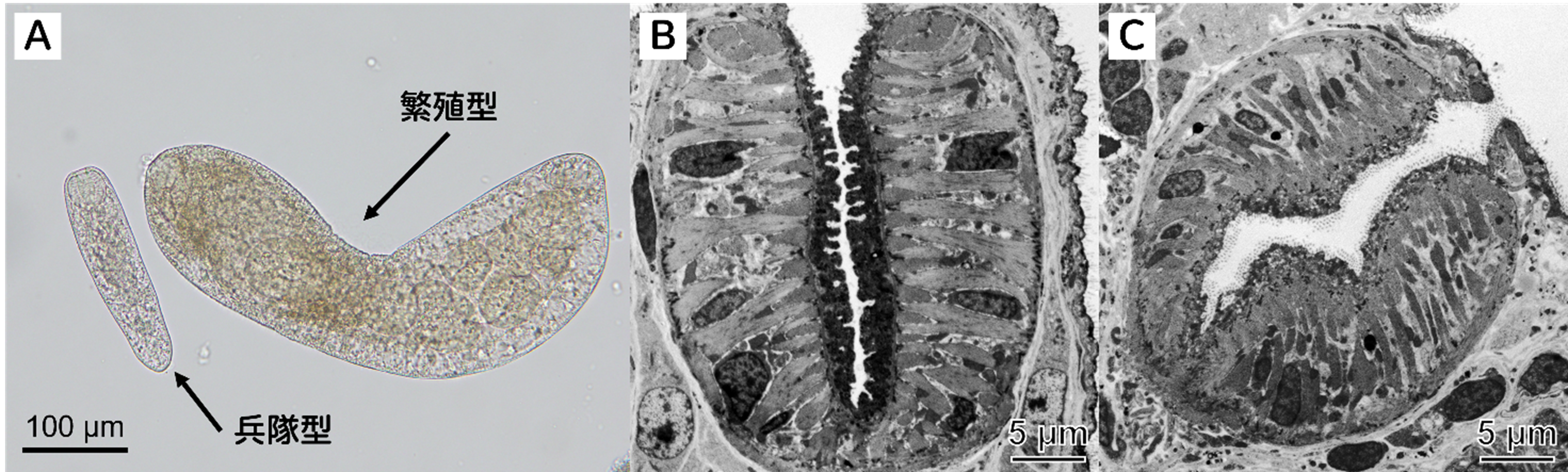
A: Cercaria batillariae のレジア、B:兵隊型レジアの咽頭、C: 繁殖型レジアの咽頭
<関連情報>
- https://www.hokudai.ac.jp/news/2026/03/post-2201.html
- https://www.hokudai.ac.jp/news/pdf/260302_pr.pdf
- https://royalsocietypublishing.org/rsbl/article/22/2/20250687/480307/Anatomical-and-functional-specialization-of-the
異形吸虫科吸虫 Cercaria batillariae の兵隊カーストにおける解剖学的・機能的特殊 Anatomical and functional specialization of the soldier caste in a heterophyid trematode, Cercaria batillariae
Kentaro Miura;Satoshi Wada;Osamu Miura
Biology Letters Published:11 Feb 2026
DOI:https://doi.org/10.1098/rsbl.2025.0687
Abstract
The presence of a soldier caste is a hallmark of the reproductive division of labour. Trematodes reproduce asexually and form a colony in snails, the first intermediate host. Several trematode species produce morphologically and behaviourally specialized soldiers for defending colony members. These soldiers often possess disproportionately large pharynxes, which serve as a weapon for sucking and attacking their enemies. Here, we demonstrate further anatomical and functional specialization in trematode soldiers. We found that Cercaria batillariae HL7 exhibits the reproductive division of labour with reproductive and soldier castes. Transmission electron microscopy (TEM) revealed that the pharynxes of the soldiers were not just larger than those of the reproductives but were covered by a tegument with serrated projections, coupled with thick bundles of radial muscle fibres, consistent with enhancing the role of soldiers in attaching to and sucking on enemies with their mouths and pharynxes. These sucker structures are analogous to those seen in octopuses. The TEM images further revealed that at least some soldiers of C. batillariae lack a germinal mass, suggesting they are at least temporarily sterile. Our study facilitates the understanding of the trematode social system by providing fine-scale structural differences between the reproductive and soldier castes.