2026-03-06 東京科学大学
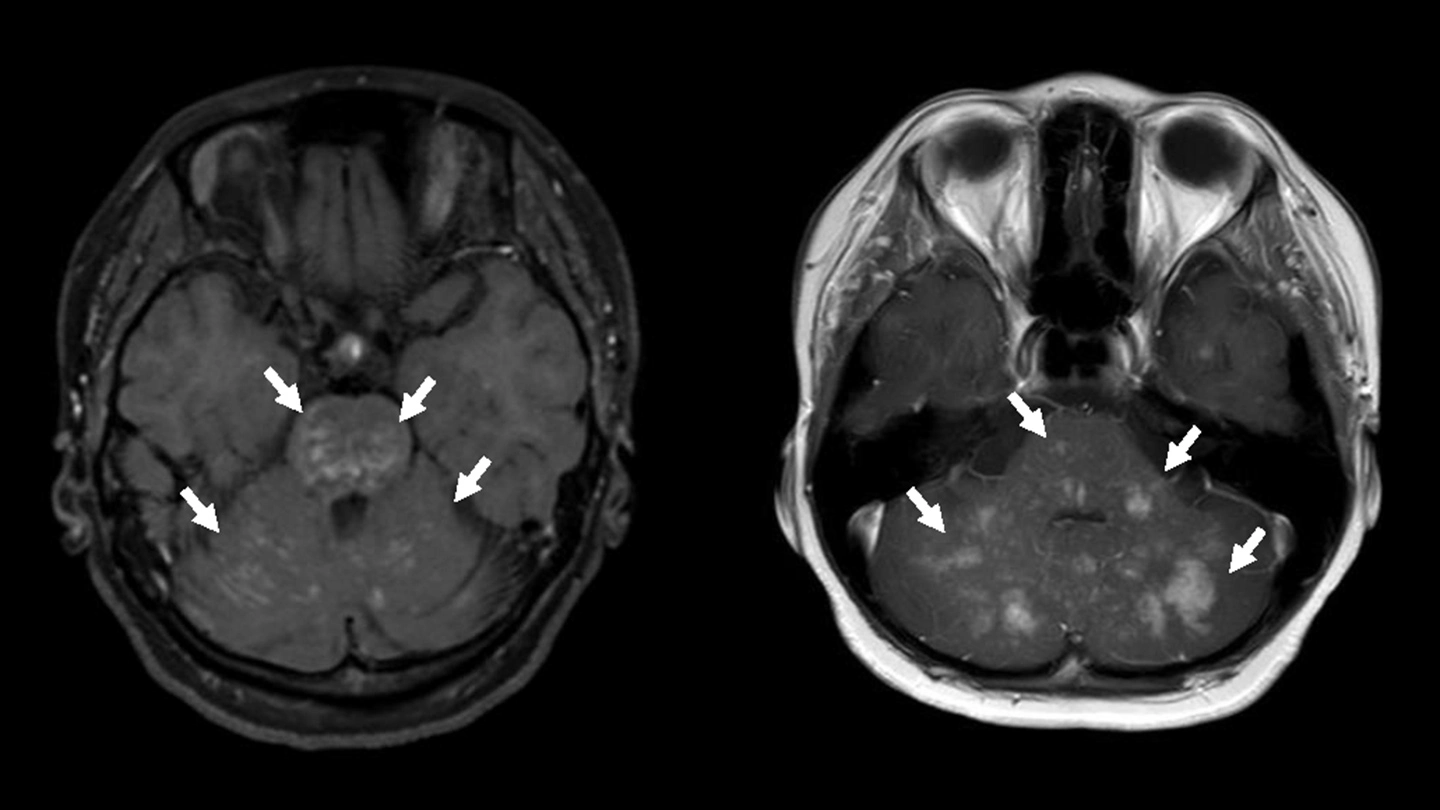
本研究で報告した2症例の頭部MRI(造影T1強調)画像:小脳と脳幹に、白く造影される点状・結節状の病変を多数認め(矢印)、CLIPPERSに類似する所見を示した。
<関連情報>
- https://www.isct.ac.jp/ja/news/jpziaopl8oa3
- https://link.springer.com/article/10.1007/s10875-026-01988-1
UNC13D低形質変異を共有するCLIPPERS様症候群の2症例 Two Cases of CLIPPERS-like Syndrome Sharing a Hypomorphic UNC13D Variant
Hirotaka Sagawa,Kosei Hirata,Saori Katayama,Hirofumi Shibata,Etsushi Toyofuku,Shuya Kaneko,Yu Katata,Yusuke Takezawa,Mitsugu Uematsu,Iichiroh Onishi,Yuto Yamazaki,Takaaki Hattori,Masahide Yamamoto,Masaki Shimizu,Kohsuke Imai,Takahiro Yasumi,Tomohiro Morio,Takanori Yokota,Yoji Sasahara & Hirokazu Kanegane
Journal of Clinical Immunology Published:04 March 2026
DOI:https://doi.org/10.1007/s10875-026-01988-1
Abstract
Chronic lymphocytic inflammation with pontine perivascular enhancement responsive to steroids (CLIPPERS) syndrome is a central nervous system (CNS) inflammatory disease characterized by contrast-enhanced MRI findings of salt-and-pepper-like lesions predominantly affecting the brainstem and cerebellum. We report two patients with CLIPPERS-like brain MRI findings who carried the same missense UNC13D variant in one allele along with deleterious variants in the opposite allele. Patient 1, a 23-year-old female, presented at 15 years of age with neurological symptoms and an MRI showing spontaneously resolving, contrast-enhancing lesions in the cerebellum. At age 16, the patient experienced an episode with systemic manifestations followed by recurrent CNS lesions that responded to steroid therapy. At age 22, the patient developed punctate to nodular contrast-enhancing lesions in the brainstem, cerebellum, and cerebrum, findings consistent with CLIPPERS. Patient 2, an 18-year-old female, presented at age 11 with ataxia and dysarthria, and an MRI showing multiple contrast-enhancing lesions in the cerebellum and brainstem, consistent with CLIPPERS MRI findings. Cerebellar biopsy revealed perivascular CD4+ T-lymphocyte infiltration, and the patient responded to steroid therapy, leading to an initial diagnosis of CLIPPERS. These patients were suspected of having inborn errors of immunity and were identified to have compound heterozygous UNC13D variants along with downregulated Munc13-4 protein. Both patients underwent allogeneic hematopoietic cell transplantation, with patient 1 remaining neurologically stable for two years post-transplantation, while patient 2 experienced a post-transplant relapse requiring steroid therapy. These cases highlight that biallelic variants in the UNC13D gene may cause CNS-predominant inflammation that mimics CLIPPERS.