2026-03-10 京都大学
<関連情報>
- https://www.kyoto-u.ac.jp/ja/research-news/2026-03-10-0
- https://www.kyoto-u.ac.jp/sites/default/files/2026-03/web_2603_Kondo-9e5e1b45d6d90b8615f13bbd4294e431.pdf
- https://www.nature.com/articles/s41598-026-36570-7
筋肉と破骨細胞の代謝物は大腿骨頸部骨粗鬆症の指標となる The metabolites for muscle and osteoclast activity are indicators of femoral neck osteoporosis
Masahiro Kameda,Mitsuhiro Yanagida & Hiroshi Kondoh
Scientific Reports Published:12 February 2026
DOI:https://doi.org/10.1038/s41598-026-36570-7
Abstract
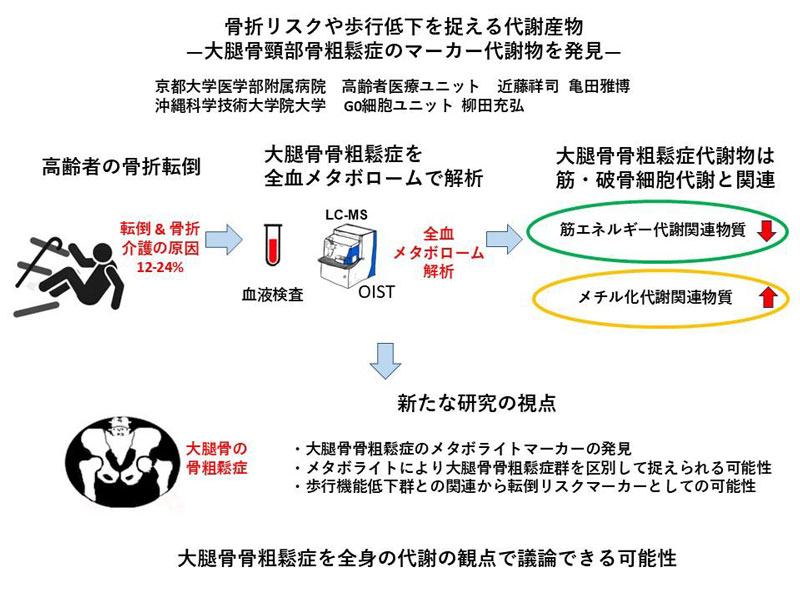
Femoral neck osteoporosis is a critical risk factor for a bedbound state, which significantly decreases overall life expectancy, if a patient falls and suffers a fracture. We performed a comprehensive blood metabolomic analysis of elderly individuals with and without femoral neck osteoporosis. Among the 129 metabolites that were identified, the abundance of six metabolites was significantly affected by femoral neck osteoporosis; decreases in phosphocreatine, malate, succinate, and histidine levels and increases in N1-methyladenosine and S-adenosylmethionine levels. The decline in muscle metabolite levels suggests that leg muscle activity is connected to the maintenance of bone mass; consistent with this, we also observed that TCA metabolite levels and leg muscle mass were decreased in patients with femoral neck osteoporosis. Interestingly, as creatine kinase is also activated in osteoclasts, the observed change in blood phosphocreatine levels reflects a change in bone homeostasis. On the other hand, as S-adenosyl-methionine serves as a donor in methylation reactions important for several biological processes, including osteoclast differentiation, increases in the levels of two methylation-related compounds (N1-methyladenosine and S-adenosyl-methionine) might indicate a link to osteoclast activity. These indicators have revealed novel aspects of the metabolic link between bone and muscle metabolism and methylation in femoral neck osteoporosis.