2026-03-13 シカゴ大学
<関連情報>
- https://news.uchicago.edu/story/mutant-gene-behind-aggressive-adult-leukemia-offers-new-clues-treatment
- https://www.nature.com/articles/s41408-025-01350-5
成人におけるTP53変異型急性リンパ性白血病の臨床的および分子学的特徴 Clinical and molecular characterization of TP53-mutant acute lymphoblastic leukemia in adults
Ethan J. Harris,Diren Arda Karaoglu,Madina Sukhanova,Yasmin Abaza,Theodoros Karantanos,Ann-Kathrin Eisfeld,Clare Anderson,Chenyu Lin,Yenny A. Moreno Vanegas,Talha Badar,Alexander Coltoff,Todd C. Knepper,Neval Ozkaya,Hamed Rahmani Youshanlouei,Sinan Cetin,Anand A. Patel,Adam S. DuVall,Michael W. Drazer,Peng Wang,Melissa Tjota,Jeremy P. Segal,Girish Venkataraman,Sandeep Gurbuxani,Jason X. Cheng,… Caner Saygin
Blood Cancer Journal Published:14 August 2025
DOI:https://doi.org/10.1038/s41408-025-01350-5
Abstract
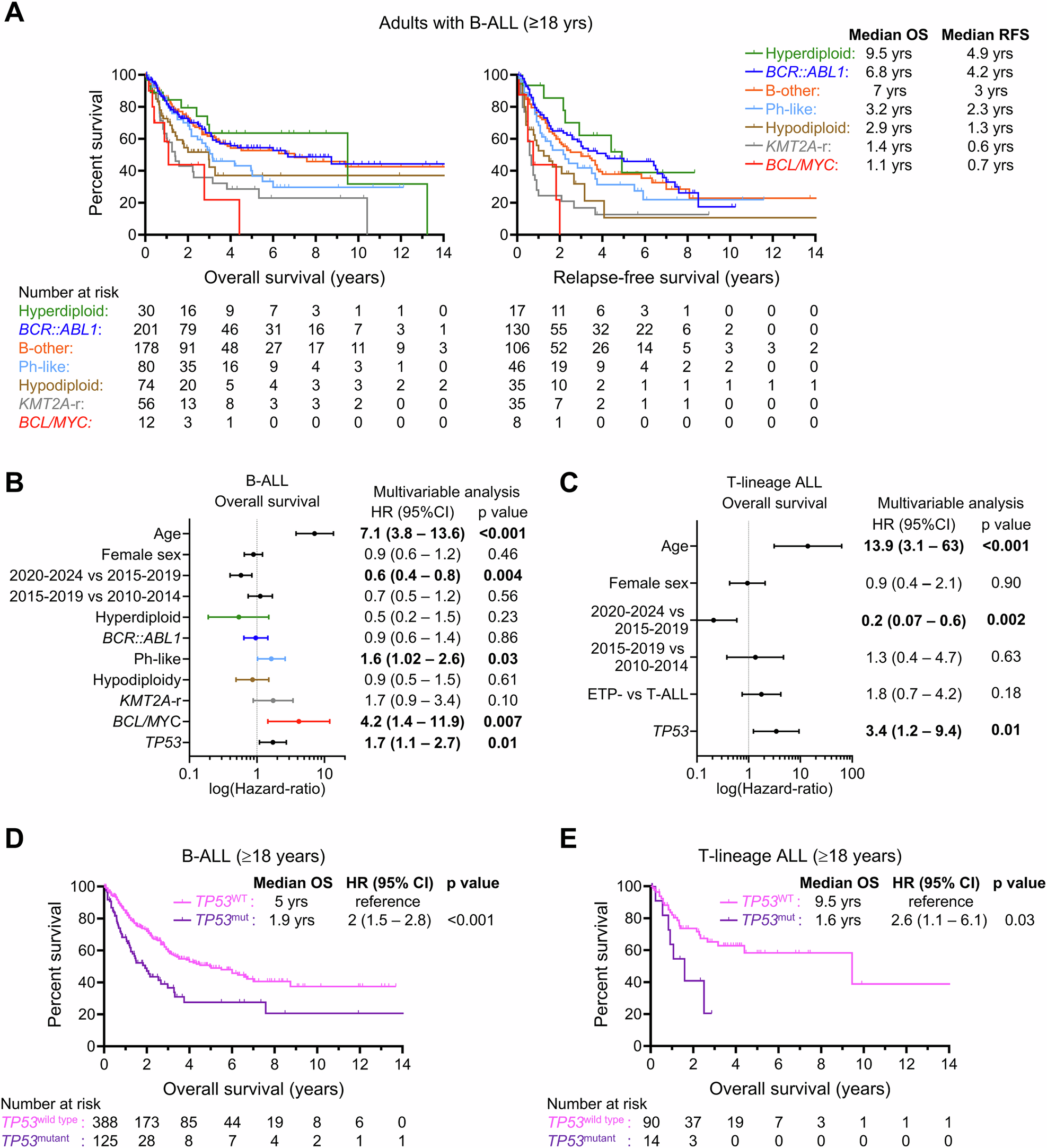
TP53-mutant acute lymphoblastic leukemia (ALL) in adults is a high-risk subtype with poor outcomes, yet its molecular landscape and clinical implications remain incompletely defined. In this multi-institutional study of 830 adult ALL patients treated at eight academic centers between 2010 and 2024, we demonstrated that TP53 mutations are independent predictors of inferior overall survival in both B-ALL (median, 1.9 vs 5 years) and T-ALL (1.6 vs 9.5 years), irrespective of age, biologic disease subtype, or therapy. Genomic profiling revealed that >90% of TP53 mutations were DNA-binding domain missense variants, frequently co-occurring with hypodiploidy in B-ALL and NOTCH1/FBXW7 mutations in T-ALL. Unlike myeloid malignancies, biallelic TP53 mutations did not worsen outcomes, and variant type (missense vs truncating) did not influence survival. TP53-mutant B-ALL exhibited higher CD20 positivity than TP53-wild type B-ALL (65% vs 31%) but had inferior responses to conventional chemotherapy. Novel immunotherapies (e.g., inotuzumab/blinatumomab) or venetoclax-containing combination regimens improved remission rates, yet relapses were common, often with CD19/CD20/CD22 loss (triple-negative) or acquisition of new mutations. Allogeneic transplantation in first remission trended toward survival benefit (median, 3.3 vs 2.2 years). These findings underscore TP53-mutant ALL as a distinct, chemo-resistant entity necessitating tailored approaches, with antigen escape highlighting challenges of immunotherapy durability.