2026-03-30 東京科学大学
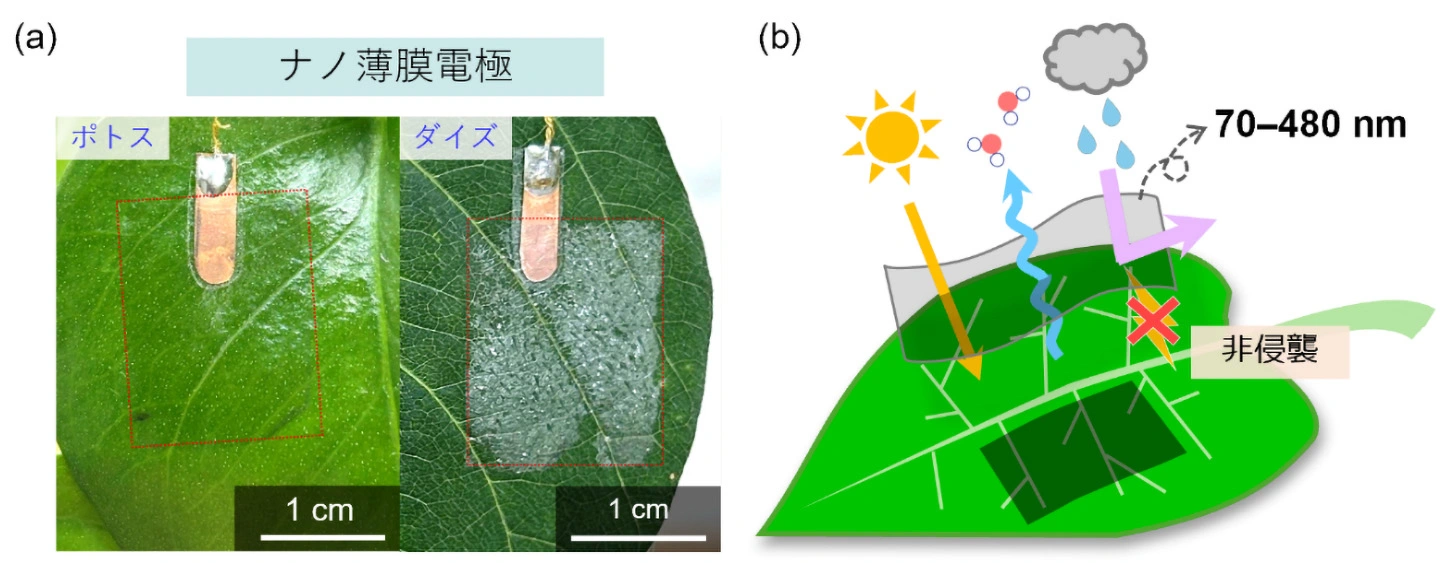
図1. (a) 葉面に貼付したナノ薄膜電極の概観。(b) 透明で、透湿性と耐水性に優れ、非侵襲的なナノ薄膜電極の概念図。
<関連情報>
- https://www.isct.ac.jp/ja/news/6k2gz7m12319
- https://advanced.onlinelibrary.wiley.com/doi/10.1002/advs.202522824
植物電気生理学の長期モニタリングのための、貫通可能で耐水性かつ透明なカーボンナノチューブからなるナノフィルム電極 Pierceable, Water-Resistant, and Transparent Nanofilm Electrodes Comprising Carbon Nanotubes for Long-Term Monitoring of Plant Electrophysiology
Yusuke Hori, Tatsuhiro Horii, Shinji Masuda, Toshinori Fujie
Advanced Science Published: 23 March 2026
DOI:https://doi.org/10.1002/advs.202522824
ABSTRACT
Trichomes are found on the surfaces of many crops, making it challenging to design sensors that monitor plant conditions without interfering with their natural functions. Notably, conventional and advanced electrodes developed for plant electrophysiology have not overcome this challenge. Herein, we present thin-film composite electrodes that are transparent, water-vapor-permeable, water-resistant, non-invasive, pierceable by trichomes, and conformal to the complex surfaces of leaves, ensuring low contact impedance without the need for adhesives. The bilayer electrodes (referred to as “nanofilm electrodes”) are composed of single-walled carbon nanotubes (SWCNTs) deposited on poly(styrene-b-butadiene-b-styrene), and the thickness is varied (70–480 nm) to evaluate its influence. Furthermore, the sensing performance and long-term stability are compared with those of commercial wet electrodes and conventional poly(3,4-ethylenedioxythiophene):poly(4-styrenesulfonate) electrodes. The proposed SWCNT nanofilm electrodes enable stable detection of electrophysiological changes in leaves for over 2 months, as well as light-induced biopotential signals under chemical stress, highlighting their potential for long-term, real-time plant health monitoring in smart agriculture systems.