2026-03-31 東北大学
東北大学などの研究グループは、新型コロナ流行が社会生活や健康に与えた影響を把握するため、約3万人を対象とした大規模インターネット追跡調査「JACSIS研究」を実施し、そのデータ構造や調査設計をまとめた論文を発表した。本調査は2020年以降継続され、収入・雇用、メンタルヘルス、生活習慣、ワクチン接種など幅広い項目を収集。さらにコロナ前のJASTIS研究データと連結することで、流行前後の変化を長期的かつ包括的に比較できる点が特徴である。得られたデータは健康格差の解明や政策立案に資する基盤として期待され、今後も継続的な研究とデータ共有が進められる。
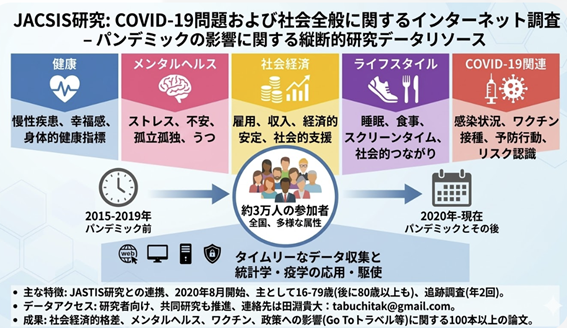
図1. JASCSIS研究の概念図
<関連情報>
- https://www.tohoku.ac.jp/japanese/2026/03/press20260331-04-COVID-19.html
- https://www.tohoku.ac.jp/japanese/newimg/pressimg/tohokuuniv-press20260331_web04_COVID-19.pdf.pdf
- https://academic.oup.com/ije/article/55/2/dyag025/8512973
データリソース概要:日本における新型コロナウイルス感染症と社会に関するインターネット調査(JACSIS) Data Resource Profile: The Japan COVID-19 and Society Internet Survey (JACSIS)
Hidehiro Someko ,Keisuke Anan ,Takahiro Tabuchi ,Takashi Yoshioka ,Ryo Okubo ,Yuki Furuse ,Kota Katanoda ,Takeo Fujiwara ,Naoki Kondo ,Yosuke Yamamoto
International Journal of Epidemiology Published:10 March 2026
DOI:https://doi.org/10.1093/ije/dyag025
Data resource basics
Key Features
- The Japan COVID-19 and Society Internet Survey (JACSIS) was established in 2020 to investigate the multifaceted impacts of the COVID-19 pandemic, enabling the comparison of pre- and post-pandemic data through linkage with the previous Japan “Society and New Tobacco” Internet Survey (JASTIS) studies (6494 participants from pre-pandemic period; 7351 from pandemic onset).
- The study commenced in August 2020 in Japan with 28 000 initial participants (25 482 after excluding satisficers) comprising Japanese adults aged 16–79 years in Wave 1, expanded to include those aged ≥80 years in Wave 8, with approximately equal gender distribution.
- Follow-up surveys have been conducted twice a year, maintaining ∼30 000 participants per wave through replacement sampling (response rates: ∼60% for previous participants, ∼30% for new panelists); the dataset includes 74 003 unique individuals due to the re-recruitment of previous participants.
- Data collection encompasses demographics, socioeconomic factors, validated health scales such as Kessler-6, COVID-19 assessments (fear of COVID-19, vaccine attitudes, etc.), lifestyle behaviors (tobacco/alcohol use, gambling), social measures (Lubben Scale, childhood experiences), and pandemic impacts on healthcare utilization and daily activities (hospital visits, influenza vaccination, work from home).
- The dataset is available to external researchers through collaborative research frameworks; contact the corresponding author at tabuchitak@gmail.com for the application procedures.