2026-04-01 東北大学
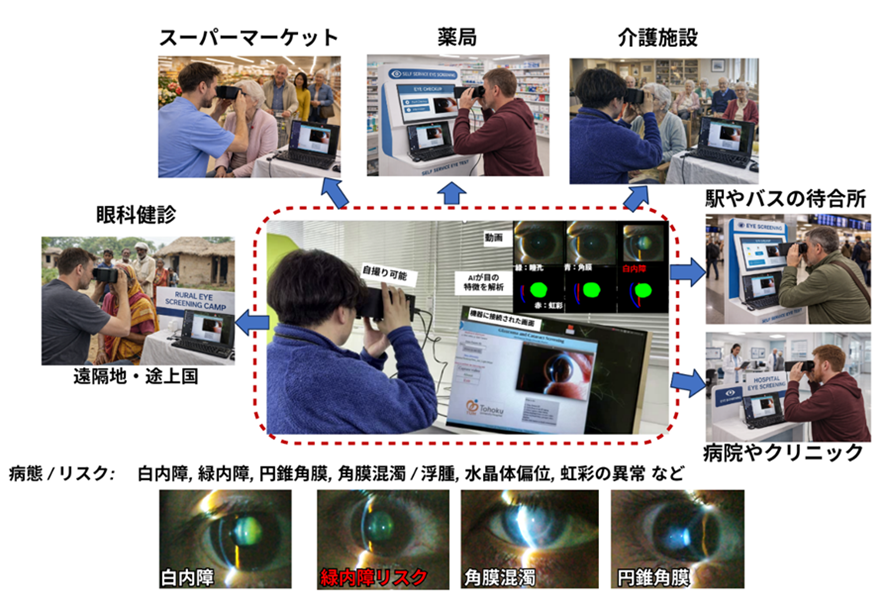
図1. 検査の有用性 あらゆるところで検査ができ、多くの疾患を発見
<関連情報>
- https://www.tohoku.ac.jp/japanese/2026/04/press20260401-04-eye.html
- https://www.tohoku.ac.jp/japanese/newimg/pressimg/tohokuuniv-press20260401_web04_eye.pdf
- https://www.nature.com/articles/s41598-026-44392-w
低コストの眼疾患スクリーニングのための、AI搭載型携帯型スキャン式スリットライト装置 Portable AI-powered scanning slit-light device for low-cost eye disease screening
Neelam Kaushik,Parmanand Sharma,Takehiro Miya,Noriko Himori,Masataka Sato,Satoru Tsuda & Toru Nakazawa
Scientific Reports Published:17 March 2026
DOI:https://doi.org/10.1038/s41598-026-44392-w Unedited version
Abstract
Accurate anterior-segment assessment is essential for detecting conditions such as primary angle-closure glaucoma, cataract, and keratoconus, yet current tools remain limited: slit-lamp biomicroscopy is qualitative and operator-dependent, whereas anterior segment OCT (AS-OCT) is costly and clinic-bound. We introduce an AI-integrated portable scanning slit-light device that delivers quantitative anterior-segment biometry at a material cost below USD 500. The system combines a motorized slit-scanning mechanism with synchronized imaging and an on-device deep-learning model (LWBNA-unet) to segment corneal and iris reflections, pupil boundaries, and corneal surfaces. Geometry-aware corrections—including slit-incidence compensation and per-frame anatomical scaling—enable calibrated estimation of anterior chamber depth (ACD) as the primary quantitative output, with exploratory estimates of central corneal thickness (CCT) derived from the same scan. In a clinical study of 170 participants, ACD showed excellent agreement with AS-OCT (Pearson’s r ≈ 0.92, concordance correlation coefficient ≈ 0.90; mean bias ≈ 0.0–0.04 mm with 95% limits of agreement LoR ~ ± 0.3 mm) indicating near-clinical interchangeability for ACD in a screening context. Representative cases illustrated clear visualization of anterior-segment features associated with narrow angles, cataract, corneal opacity, and keratoconic ectasia from a single scanning-slit video. A typical 51-frame video (captured in ~ 15 s) can be fully processed on a Jetson Orin Nano in 18.5 s (≈ 2.7 fps), supporting compact, battery-powered deployment. These results establish the first ultra–low-cost platform capable of automated, quantitative, and anatomically calibrated anterior-segment imaging, offering a scalable foundation for community screening and teleophthalmology in resource-limited settings.