2026-04-01 アメリカ国立衛生研究所(NIH)
<関連情報>
- https://www.nih.gov/news-events/news-releases/nih-researchers-discover-pain-relieving-drug-minimal-addictive-properties
- https://www.nature.com/articles/s41586-026-10299-9
副作用が最小限のμ-オピオイド受容体スーパーアゴニスト鎮痛薬 A µ-opioid receptor superagonist analgesic with minimal adverse effects
Juan L. Gomez,Emilya N. Ventriglia,Zachary J. Frangos,Agnieszka Sulima,Michael J. Robertson,Michael D. Sacco,Reece C. Budinich,Ilinca M. Giosan,Tongzhen Xie,Oscar Solis,Anna E. Tischer,Jennifer M. Bossert,Kiera E. Caldwell,Hannah Bonbrest,Amelie Essmann,Zelai M. Garçon-Poca,Shinbe Choi,Michael R. Noya,Feonil Limiac,Ali Arce,Grant C. Glatfelter,Margaret Robinson,Li Chen,Angelina A. Mullarkey,… Michael Michaelides
Nature Published:01 April 2026
DOI:https://doi.org/10.1038/s41586-026-10299-9
Abstract
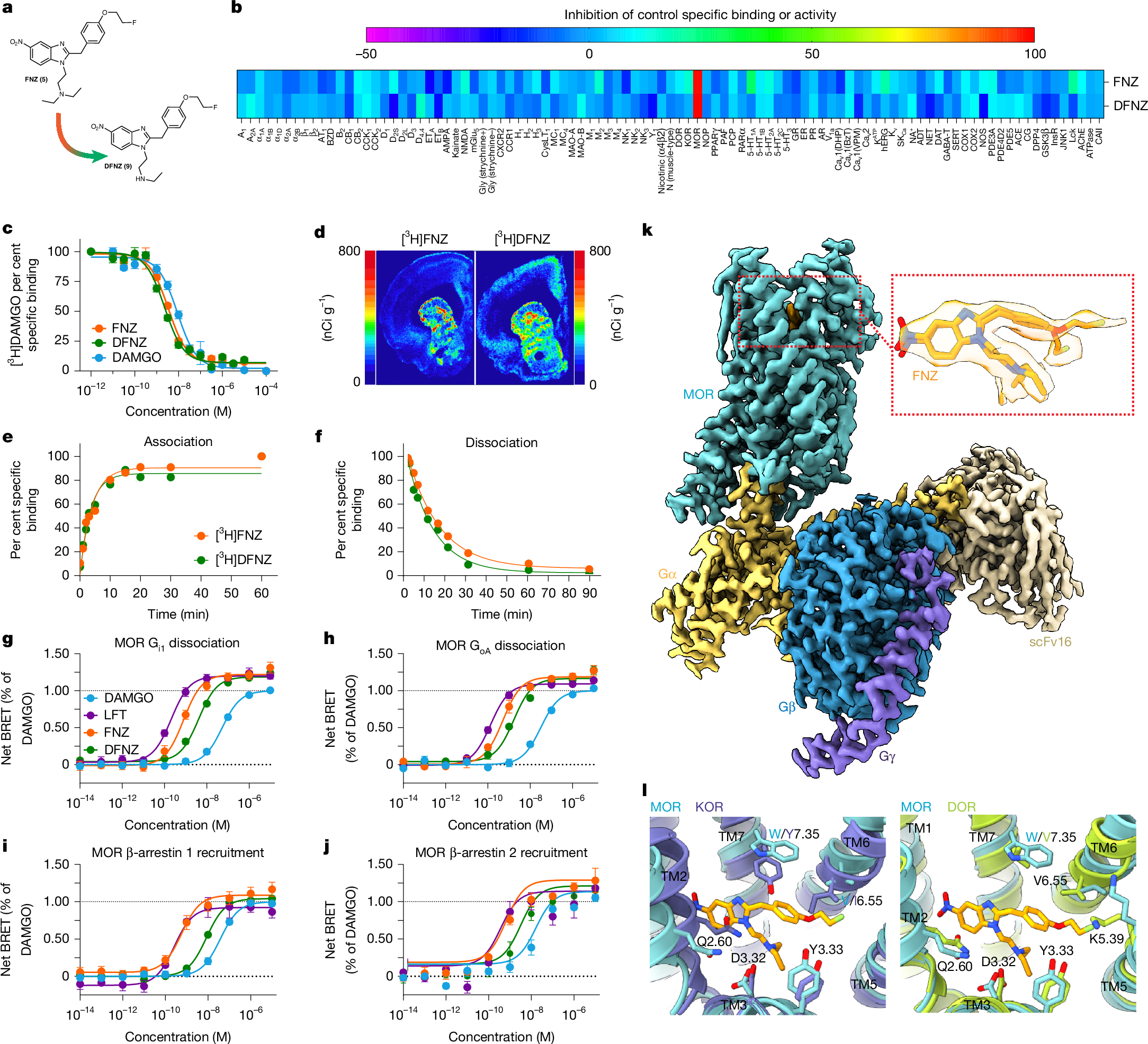
Developing safe and effective pain medications is an ongoing challenge for human health. Agonists for the µ-opioid receptor (MOR) are essential pain medications, but their high intrinsic efficacy also induces adverse side effects, including respiratory depression, constipation, tolerance, dependence, withdrawal and addiction1,2,3,4,5,6,7. Strategies to limit adverse effects traditionally include developing MOR agonists that have low intrinsic efficacy or that preferentially activate G-protein signalling over β-arrestin signalling8. Here we identify a novel MOR agonist with supramaximal intrinsic efficacy and a unique pharmacological profile that produced effective analgesia in rodents with minimal adverse effects. N-desethyl-fluornitrazene (DFNZ) was derived from a class of synthetic benzimidazole opioids called nitazenes. DFNZ has impaired brain penetrance, a unique spatiotemporal MOR cellular signalling profile, and diminished efficacy at the MOR–galanin 1 receptor (GAL1) heteromer. DFNZ does not induce respiratory depression, tolerance or MOR downregulation after repeated exposure. Compared with other MOR agonists, DFNZ has limited effects on dopamine neurotransmission in nucleus accumbens and weaker reinforcing effects in the drug self-administration procedure. These results provide novel insights about MOR and nitazene pharmacology, have important implications for pain and addiction treatment, and challenge the prevailing dogma that high-efficacy MOR agonists cannot constitute safe and effective therapeutic agents.