2026-04-02 中国科学院(CAS)
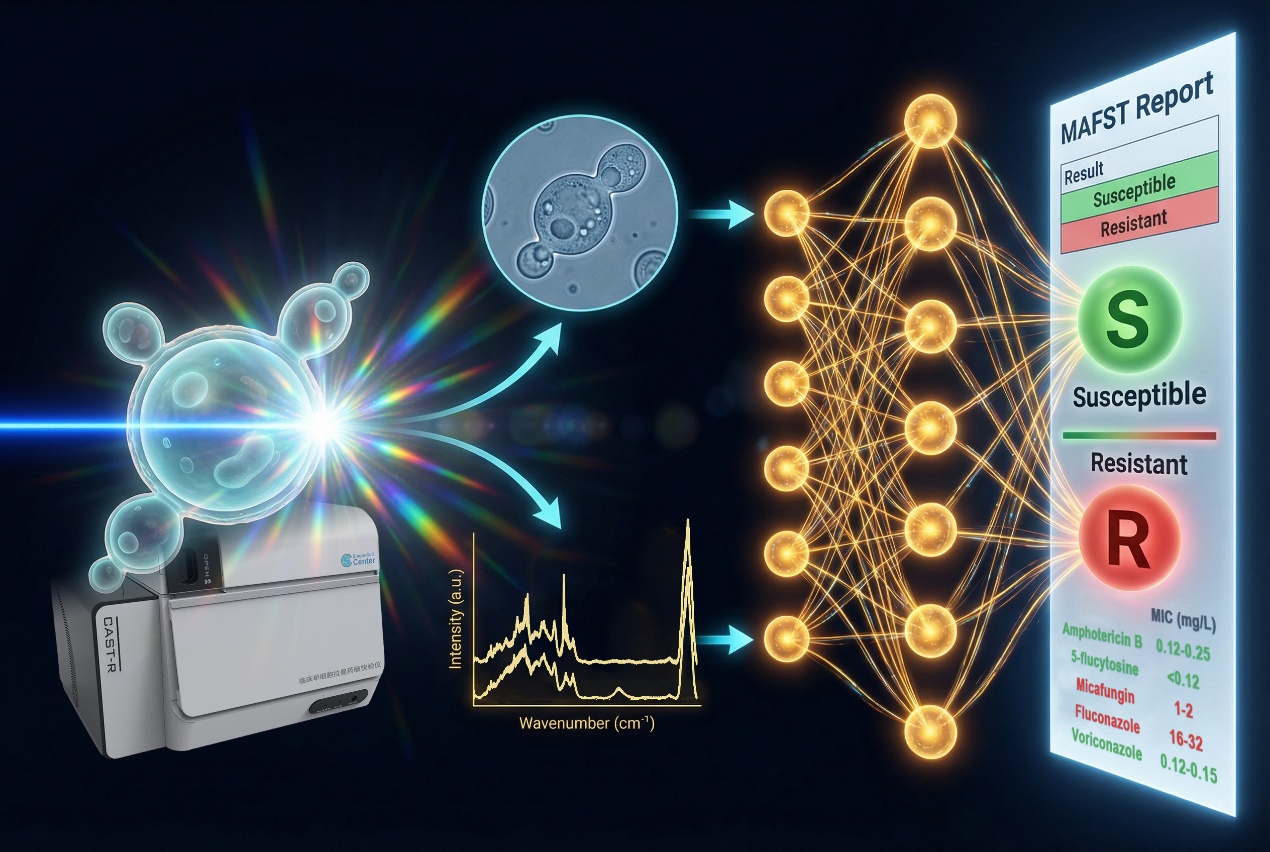
AI-assisted multimodal platform for rapid antifungal susceptibility testing (Image by LIU Yang)
<関連情報>
- https://english.cas.cn/newsroom/research-news/202604/t20260402_1155062.shtml
- https://pubs.acs.org/doi/10.1021/acs.analchem.5c06899
単一細胞の形態、発達、代謝による抗真菌薬感受性試験 Antifungal Susceptibility Test via Single-Cell Morphology, Development, and Metabolism
Xiao Han,Yanmei Zhang,Xiaoshan Zheng,Xixian Wang,Rongze Chen,Min Liu,Qiwen Yang,Guanghua Huang,Yu Vincent Fu,Bo Ma,Jiadong Huang,Jian Xu
Analytical Chemistry Published: March 27, 2026
DOI:https://doi.org/10.1021/acs.analchem.5c06899
Abstract
Antifungal susceptibility test (AFST) is essential for guiding effective therapy, but it remains challenged by long turnaround times and the limited generalizability of single-parameter phenotypic readouts across diverse fungal species and antifungal classes. Here, we present a multifeature AFST (MAFST) platform that integrates single-cell Raman spectroscopy and brightfield imaging to enable rapid and pleiotropic assessment of antifungal responses. By unifying complementary metabolic and morphological features into a composite inhibition index (CII), MAFST captures coordinated cellular responses to antifungal exposure that cannot be reliably resolved by individual metrics alone. Benchmarking against the broth microdilution demonstrates that CII-based MAFST achieves high concordance across multiple Candida species and antifungal classes while substantially reducing the time required for susceptibility determination. Thus, by capturing single-cell morphological, developmental, and metabolic drug responses in a fast, accurate, and widely applicable fashion, MAFST can contribute to tackling fungal infections.