2025-06-12 中国科学院(CAS)
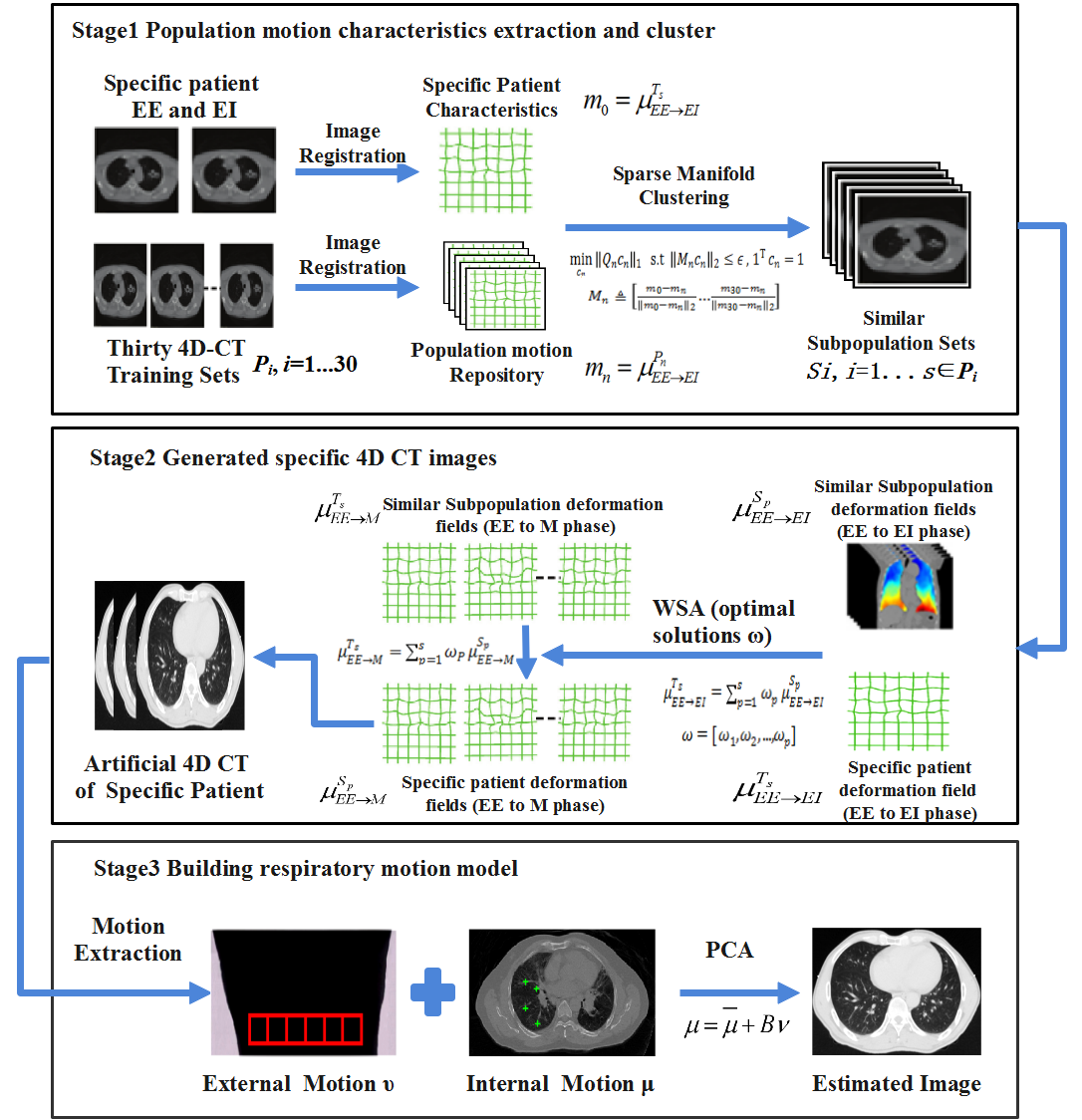 The workflow of our proposed respiratory motion modeling (Image by WANG Tengfei)
<関連情報>
- https://english.cas.cn/newsroom/research_news/life/202506/t20250613_1045558.shtml
- https://www.sciencedirect.com/science/article/abs/pii/S0895611125000667
CTガイド下肺癌インターベンションにおける正確な呼吸運動予測のための新しい集団特性重み付けスパースモデル A novel population-characteristic weighted sparse model for accurate respiratory motion prediction in CT-guided lung cancer interventions
Guo-Ren Xia, Tengfei Wang, Jun Xu, Xiaoyang Li, Hongzhi Wang, Stephen T.C. Wong, Hai Li
Computerized Medical Imaging and Graphics Available online: 17 April 2025
DOI:https://doi.org/10.1016/j.compmedimag.2025.102557
Highlights
- Integrating the advantages of global and individual models can improve performance.
- Extracts subpopulations similar to individual subjects to reduce the differences in population respiratory characteristics.
- Combining two 3D CT from respiratory phases can eliminate the obligation to get 4D CT.
- Multi-center data have validated the robustness and clinical usability of the model.
Abstract
Accurate tracking of lung nodule movement is a critical challenge for image-guided interventions. Current approaches typically rely on respiratory motion modeling to optimize diagnosis and treatment. Population-based motion models predict lung movement in real time by extracting common features of lung motion from the group-level imaging data, but they usually overlook individual differences. Conversely, patient-specific models require patient-specific four-dimensional computed tomography (4D CT), which increases radiation damage. This study introduces a novel Population-Characteristic Weighted Sparse (PCWS) model. PCWS combines population-level motion characteristics with patient-specific data to accurately predict lung movement, eliminating the need for 4D CT acquisition. Sparse manifold clustering is employed to identify a subpopulation exhibiting motion patterns similar to those of the target patient. The respiratory motion field for the specific patient is then approximated using a sparse linear combination of motion data from this subpopulation. Experimental results demonstrate that the PCWS model achieves an average lung estimation error of 0.20 ± 0.15 mm, validating its accuracy. Meanwhile, the PCWS model outperforms three other advanced models in prediction accuracy, effectively combining the strengths of both population and patient-specific models. To evaluate the reproducibility of the PCWS model, two additional datasets from different clinical centers were used. The results confirmed its accuracy and repeatability across various evaluation criteria, further validating its superior performance. Future research will focus on applying the PCWS model to image-guided percutaneous lung biopsy and radiation therapy, aiming to enhance procedural precision and clinical outcomes.