2025-07-02 ウィスコンシン大学マディソン校(UW-Madison)
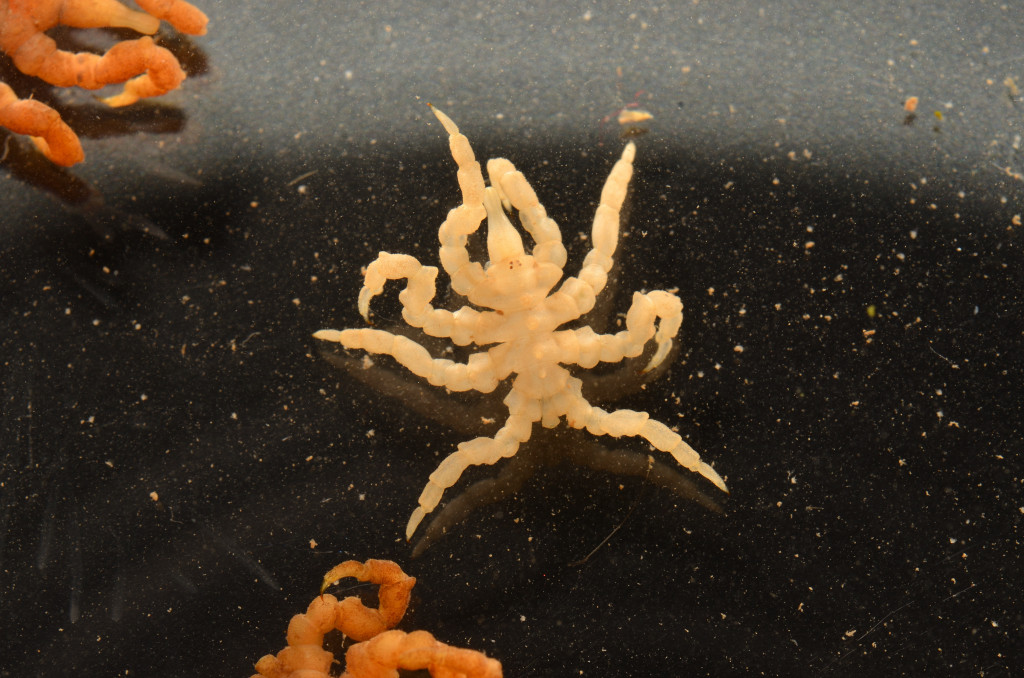
The knotty sea spider, Pycnogonum litorale, is not actually a spider, but it does represent a significant early branch in the genetic family tree that includes spiders, as well as scorpions, ticks and horseshoe crabs. That makes it “an important reference for the evolution of all these species,” says UW–Madison researcher Prashant Sharma. Photo courtesy of Prashant Sharma
<関連情報>
- https://news.wisc.edu/meet-the-weird-sea-spider-thats-mapping-the-evolution-of-eight-legged-creatures/
- https://bmcbiol.biomedcentral.com/articles/10.1186/s12915-025-02276-x
ウミグモのゲノムから、節足動物で共有されるHoxクラスター・モチーフが確認される The genome of a sea spider corroborates a shared Hox cluster motif in arthropods with a reduced posterior tagma
Nikolaos Papadopoulos,Siddharth S. Kulkarni,Christian Baranyi,Bastian Fromm,Emily V. W. Setton,Prashant P. Sharma,Andreas Wanninger & Georg Brenneis
BMC Biology Published:02 July 2025
DOI:https://doi.org/10.1186/s12915-025-02276-x
Abstract
Background
Chelicerate evolution is contentiously debated, with recent studies challenging traditional phylogenetic hypotheses and scenarios of major evolutionary events, like terrestrialization. Sea spiders (Pycnogonida) represent the uncontested marine sister group of all other chelicerates, featuring a—likely plesiomorphic—indirect development. Accordingly, pycnogonids hold the potential to provide crucial insight into the evolution of chelicerate genomes and body patterning. Due to the lack of high-quality genomic and transcriptomic resources, however, this potential remains largely unexplored.
Results
We employ long-read sequencing and proximity ligation data to assemble the first near chromosome-level sea spider genome for Pycnogonum litorale, complemented by comprehensive transcriptomic resources. The assembly has a size of 471 Mb in 57 pseudochromosomes, a repeat content of 61.05%, 15,372 predicted protein-coding genes, and robust completeness scores (95.8% BUSCO Arthropoda score, 95.7% of conserved microRNA families). Genome-scale self-synteny and homeobox gene cluster analysis show no evidence of a whole-genome duplication (WGD). We identify a single, intact Hox cluster lacking Abdominal-A (abdA/Hox9), corroborated by the absence of an abdA ortholog in the novel transcriptomic resources.
Conclusions
Our high-quality genomic and transcriptomic resources establish P. litorale as a key research organism for modern studies on chelicerate genome evolution, development, and phylogeny. The lack of WGD signature in P. litorale further strengthens the inference that WGDs are derived traits in the chelicerate tree. The combination of abdA loss with the reduction of the posterior tagma emerges as a common theme in arthropod evolution, as it is shared with other, distantly related arthropod taxa with a vestigial opisthosoma/abdomen.