2025-07-04 東京大学
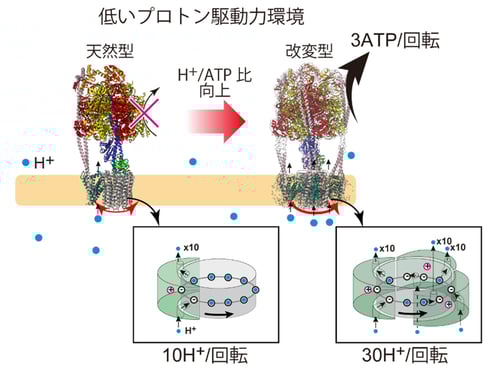
低いプロトン駆動力環境下でもATP合成を実現する改変型ATP合成酵素
<関連情報>
- https://www.t.u-tokyo.ac.jp/press/pr2025-07-04-001
- https://www.t.u-tokyo.ac.jp/hubfs/press-release/2025/0704/001/text.pdf
- https://www.nature.com/articles/s41467-025-61227-w
プロトン対ATP比を高めるATP合成酵素のエンジニアリング Engineering of ATP synthase for enhancement of proton-to-ATP ratio
Hiroshi Ueno,Kiyoto Yasuda,Norie Hamaguchi-Suzuki,Riku Marui,Naruhiko Adachi,Toshiya Senda,Takeshi Murata & Hiroyuki Noji
Nature Communications Published:03 July 2025
DOI:https://doi.org/10.1038/s41467-025-61227-w
Abstract
FoF1-ATP synthase (FoF1) interconverts the energy of the proton motive force (pmf) and that of ATP through the mechanical rotation. The H+/ATP ratio, one of the most crucial parameters in bioenergetics, varies among species due to differences in the number of H+-binding c-subunits, resulting in H+/ATP ratios ranging from 2.7 to 5. In this study, we seek to significantly enhance the H+/ATP ratio by employing an alternative approach that differs from that of nature. We engineer FoF1 to form multiple peripheral stalks, each bound to a proton-conducting a-subunit. The engineered FoF1 exhibits an H+/ATP ratio of 5.8, surpassing the highest ratios found in naturally occurring FoF1s, enabling ATP synthesis under low pmf conditions where wild-type enzymes cannot synthesize ATP. Structural analysis reveals that the engineered FoF1 forms up to three peripheral stalks and a-subunits. This study not only provides valuable insights into the H+-transport mechanism of FoF1 but also opens up possibilities for engineering the foundation of cellular bioenergetics.