2025-07-04 中国科学院(CAS)
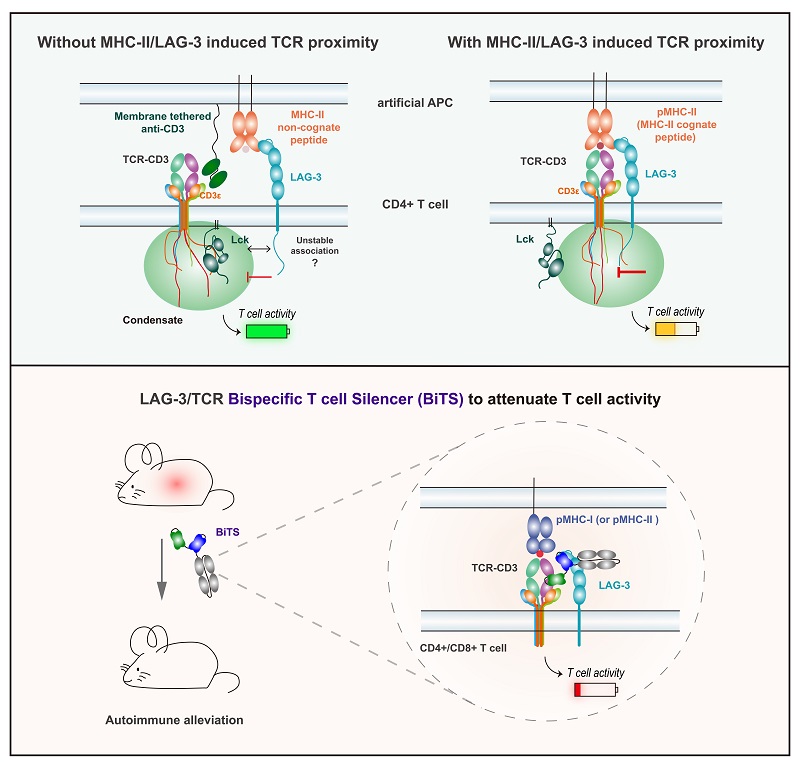 LAG-3 exerts its inhibitory function by undergoing phase separation with the CD3ε subunit of the TCR/CD3 complex; Enhancing the cis-proximity between LAG-3 and TCR through a LAG-3/TCR bispecific antibody facilitates the treatment of autoimmune diseases. (Image by LOU Jizhong’s group)
<関連情報>
- https://english.cas.cn/newsroom/research_news/life/202507/t20250703_1046716.shtml
- https://www.cell.com/cell/abstract/S0092-8674(25)00638-5
LAG-3とT細胞受容体の近接性がT細胞活性化と自己免疫の抑制を導く Proximity between LAG-3 and the T cell receptor guides suppression of T cell activation and autoimmunity
Jasper Du ∙ Hui Chen ∙ Jia You,, ∙ … ∙ Wei Chen ∙ Jizhong Lou ∙ Jun Wang
Cell Published:June 30, 2025
DOI:https://doi.org/10.1016/j.cell.2025.06.004
Highlights
- A reductionist system to dissect mechanisms of LAG-3-mediated T cell suppression
- TCR proximity but not CD4 is critical for the inhibitory function of MHC class II/LAG-3
- LAG-3 forms condensates with CD3ε intracellularly and disrupts CD3ε/Lck association
- LAG-3/TCR bispecific antibody potently suppresses CD4/CD8 T cells and autoimmunity
Summary
Therapeutically targeting pathogenic T cells in autoimmune diseases has been challenging. Although LAG-3, an inhibitory checkpoint receptor specifically expressed on activated T cells, is known to bind to major histocompatibility complex class II (MHC class II), we demonstrate that MHC class II interaction alone is insufficient for optimal LAG-3 function. Instead, LAG-3’s spatial proximity to T cell receptor (TCR) but not CD4 co-receptor, facilitated by cognate peptide-MHC class II, is crucial in mediating CD4+ T cell suppression. Mechanistically, LAG-3 forms condensate with TCR signaling component CD3ε through its intracellular FSAL motif, disrupting CD3ε/lymphocyte-specific protein kinase (Lck) association. To exploit LAG-3’s proximity to TCR and maximize LAG-3-dependent T cell suppression, we develop an Fc-attenuated LAG-3/TCR inhibitory bispecific antibody to bypass the requirement of cognate peptide-MHC class II. This approach allows for potent suppression of both CD4+ and CD8+ T cells and effectively alleviates autoimmune symptoms in mouse models. Our findings reveal an intricate and conditional checkpoint modulatory mechanism and highlight targeting of LAG-3/TCR cis-proximity for T cell-driven autoimmune diseases lacking effective and well-tolerated immunotherapies.