2025-07-03 中国科学院(CAS)
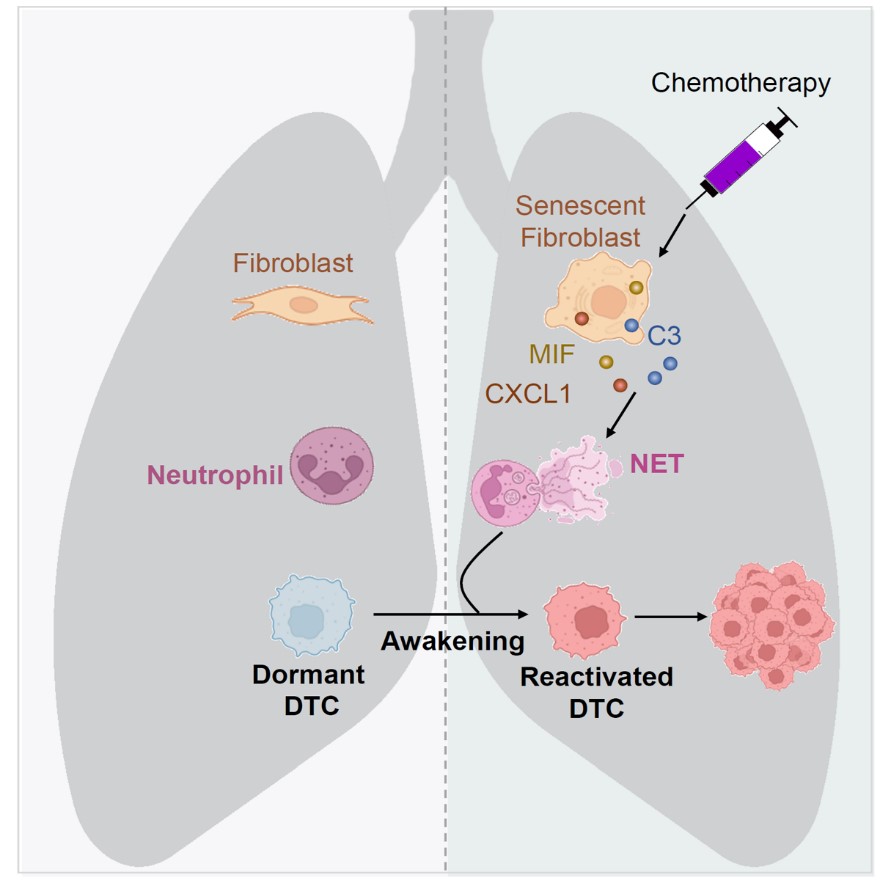
Chemotherapy awakens dormant disseminated tumor cells in lung. (Image by Prof. HU Guohong’s group)
<関連情報>
- https://english.cas.cn/newsroom/research_news/life/202507/t20250704_1046836.shtml
- https://www.cell.com/cancer-cell/abstract/S1535-6108(25)00257-0
化学療法は好中球細胞外トラップを誘導することで肺の休眠がん細胞を目覚めさせる Chemotherapy awakens dormant cancer cells in lung by inducing neutrophil extracellular traps
Dasa He ∙ Qiuyao Wu ∙ Pu Tian ∙ … ∙ Yi-zhou Jiang ∙ Zhi-Ming Shao ∙ Guohong Hu
Cancer Cell Published:July 3, 2025
DOI:https://doi.org/10.1016/j.ccell.2025.06.007
Highlights
•A recombinase-based system is developed for dormant cancer cell lineage tracing
•Chemotherapy awakens dormant DTCs and promotes metastasis
•Senescent fibroblasts and NETs mediate the effect of chemotherapy on dormancy
•Combining senolytics with chemotherapy improves treatment effect
Summary
Disseminated tumor cells (DTCs) can remain in a non-proliferative, dormant state for years in distant organs, but the exogenous causes triggering their reactivation and metastatic colonization are unclear. Here, we demonstrate that chemotherapeutic drugs, including doxorubicin and cisplatin, enhance proliferation and lung metastasis of dormant breast cancer cells. Using a recombinase-based dormancy tracing system, DormTracer, we confirm chemotherapy-induced reactivation of dormant DTCs leading to metastatic relapse. Mechanistically, chemotherapy induces fibroblast senescence, which promotes formation of neutrophil extracellular traps (NETs) through secreted proteins. NETs promote dormant DTC proliferation through extracellular matrix remodeling. Importantly, combining senolytic drugs, dasatinib and quercetin, with doxorubicin inhibits post-therapy DTC reactivation and suppresses metastatic relapse. This study provides direct evidence of dormancy awakening and reveals a mechanism underlying detrimental effect of chemotherapy on metastasis, highlighting potential strategies to improve cancer treatment.