2025-07-10 ロックフェラー大学
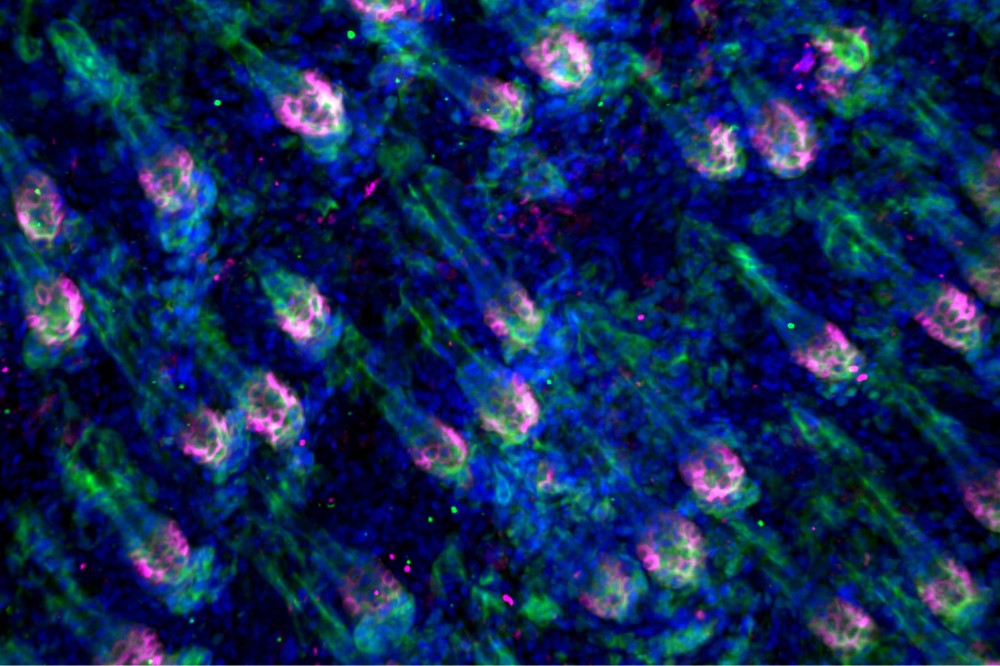
Immunofluorescent microscopy shows hair follicles in the early stages of hair regrowth. (Fuchs Lab)
<関連情報>
- https://www.rockefeller.edu/news/37997-restricting-an-amino-acid-found-in-common-foods-could-potentially-speed-up-wound-healing/
- https://www.cell.com/cell-metabolism/fulltext/S1550-4131(25)00266-9
セリン欠乏と組織傷害に伴う幹細胞の運命決定は、統合ストレス応答によって微調整される The integrated stress response fine-tunes stem cell fate decisions upon serine deprivation and tissue injury
Jesse S.S. Novak ∙ Lisa Polak ∙ Sanjeethan C. Baksh ∙ … ∙ Thomas S. Carroll ∙ Lydia W.S. Finley ∙ Elaine Fuchs
Cell Metabolism Published:June 12, 2025
DOI:https://doi.org/10.1016/j.cmet.2025.05.010
Highlights
- Deprivation of the non-essential amino acid serine activates the integrated stress response (ISR) in vivo
- The ISR favors epidermal fate and represses hair follicle fate
- Upon injury, serine-deprived HFSCs repair wounds faster and delay hair regeneration
- Pharmacologic and metabolic interventions can be used to improve wound healing
Summary
Epidermal stem cells produce the skin’s barrier that excludes pathogens and prevents dehydration. Hair follicle stem cells (HFSCs) are dedicated to bursts of hair regeneration, but upon injury, they can also reconstruct, and thereafter maintain, the overlying epidermis. How HFSCs balance these fate choices to restore physiologic function to damaged tissue remains poorly understood. Here, we uncover serine as an unconventional, non-essential amino acid that impacts this process. When dietary serine dips, endogenous biosynthesis in HFSCs fails to meet demands (and vice versa), slowing hair cycle entry. Serine deprivation also alters wound repair, further delaying hair regeneration while accelerating re-epithelialization kinetics. Mechanistically, we show that HFSCs sense each fitness challenge by triggering the integrated stress response, which acts as a rheostat of epidermal-HF identity. As stress levels rise, skin barrier restoration kinetics accelerate while hair growth is delayed. Our findings offer potential for dietary and pharmacological intervention to accelerate wound healing.