2025-07-21 中国科学院(CAS)
<関連情報>
- https://english.cas.cn/newsroom/research_news/life/202507/t20250721_1047732.shtml
- https://www.the-innovation.org/article/doi/10.59717/j.xinn-life.2025.100143
NaRaDa:新生RNAの包括的データベース NaRaDa: A comprehensive nascent RNA database
Zhibiao Mai, Duo Li, Peng Tang, Chuanman Zhou, Yongbing Zhao, Jiekai Chen, Xichen Bao
The Innovation Life Published:12 June 2025
DOI:https://doi.org/10.59717/j.xinn-life.2025.100143
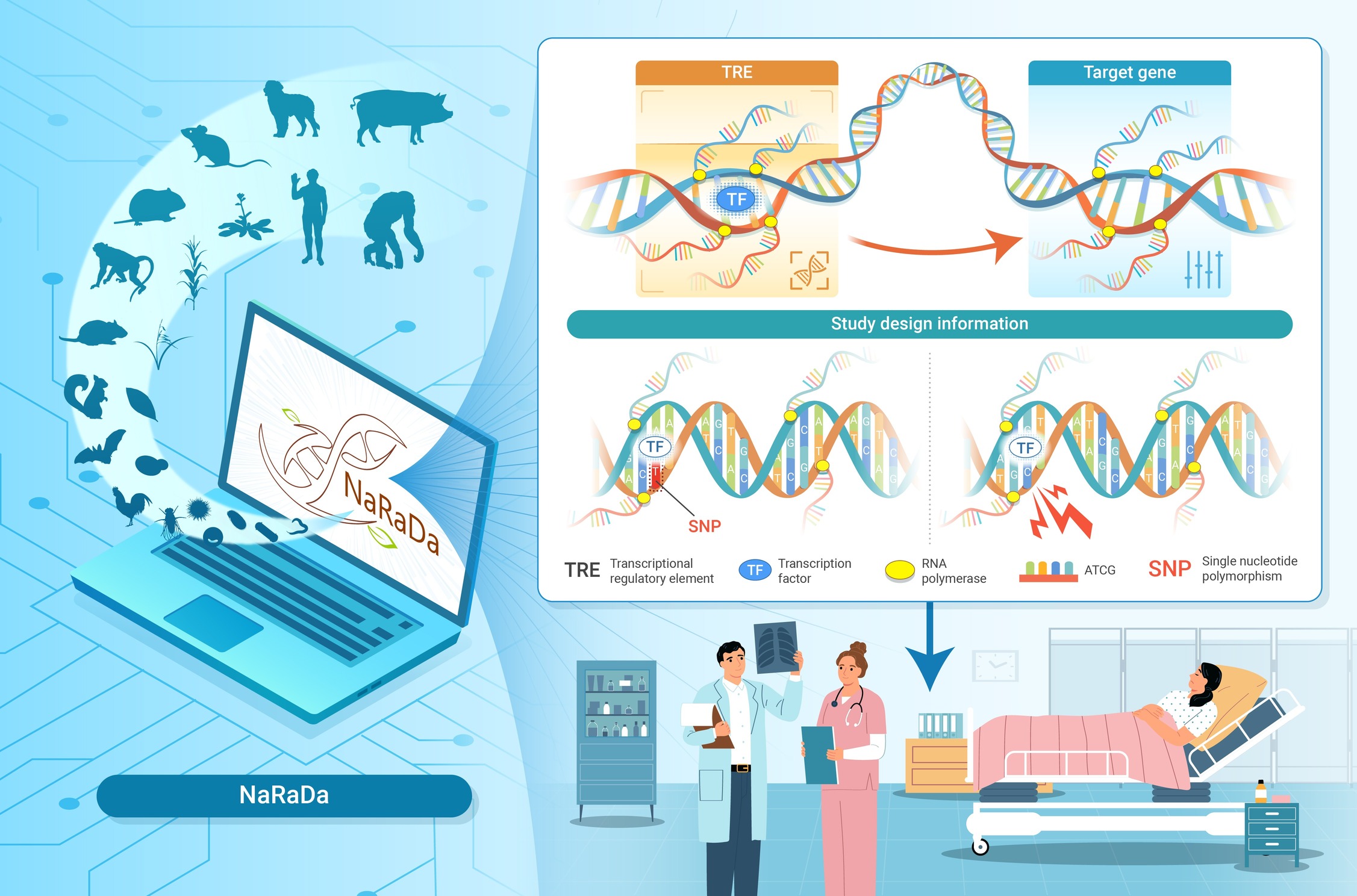
GRAPHICAL ABSTRACT
PUBLIC SUMMARY
- NaRaDa compiles and organizes 3,664 nascent RNA-seq datasets from 415 studies across 22 species.
- 558,574 transcriptional regulatory elements (TREs) across different species have been identified for browsing.
- NaRaDa also provides in-depth analysis of biological processes or events to study the transcriptional regulation.
ABSTRACT
Nascent RNA-seq is pivotal for elucidating the dynamics and transcriptional regulation of enhancer RNA and protein-coding genes, and for revealing the regulatory linkages between enhancer-gene pairs in diverse physiological and pathological contexts. However, despite the rapid growth of nascent RNA-seq datasets, a comprehensive database for the collection and analysis of these datasets remains absent. Here, we developed the Nascent RNA database (NaRaDa, http://www.narada.bio), which compiles and categorizes 3,664 global or precision run-on sequencing (GRO/PRO-seq) datasets from 415 studies across 22 species. NaRaDa provides a user-friendly interface for searching, visualizing, and assessing the quality of integrated GRO/PRO-seq datasets. Furthermore, NaRaDa identifies transcriptional regulatory elements (TREs) along with other annotation information from ENCODE, FANTOM5, and disease-associated risk SNPs, which are accessible by either “Gene-Centric” or “Project ID-Centric” modes. The database also furnishes researchers with web-based tools to identify differentially expressed genes, TREs, transcription pausing index changes, and more importantly, potential functional transcription factors, in response to specific treatments. These results can be readily downloaded for further independent analysis. NaRaDa serves as an invaluable resource for deepening our understanding of the regulatory mechanisms governing transcription and for identifying previously unrecognized correlations between genomic loci and diseases.