2025-07-29 ミシガン大学
<関連情報>
- https://news.umich.edu/coolness-hits-different-now-scientists-know-why/
- https://www.nature.com/articles/s41467-025-61562-y
マウスにおける冷感のための専用皮膚から脳への回路 A dedicated skin-to-brain circuit for cool sensation in mice
Hankyu Lee,Chia Chun Hor,Lorraine R. Horwitz,Ailin Xiong,Xin-Yu Su,Daniel R. Soden,Sarah Yang,Wei Cai,Wenwen Zhang,Chen Li,Christopher Radcliff,Abbey Dinh,Tin Long Rex Fung,Ilma Rovcanin,Kevin P. Pipe,X. Z. Shawn Xu & Bo Duan
Nature Communications Published:28 July 2025
DOI:https://doi.org/10.1038/s41467-025-61562-y
Abstract
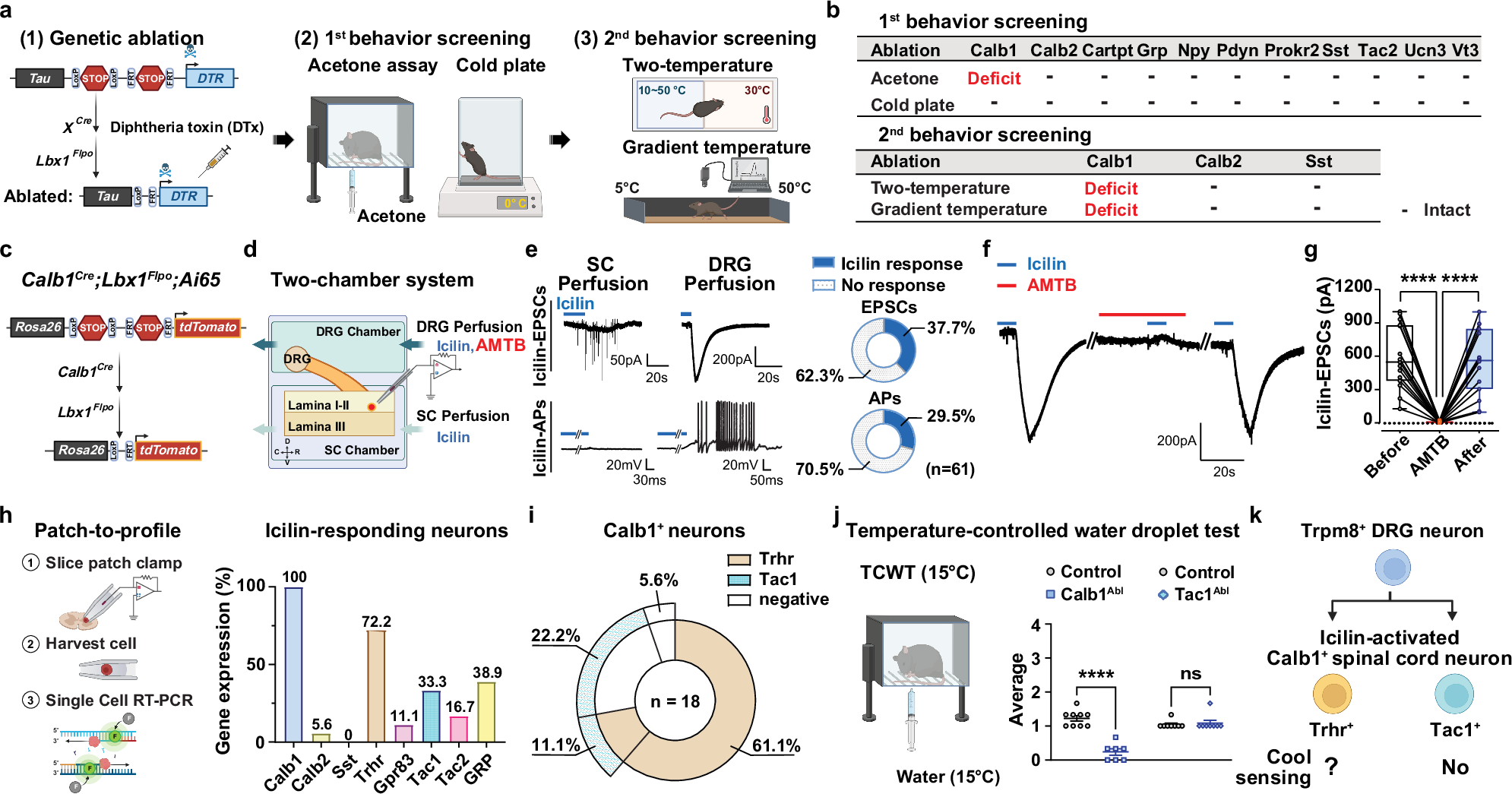
Perception of external temperature is essential for maintaining homeostasis and avoiding thermal injury. Although molecular thermosensors such as transient receptor potential melastatin type 8 (TRPM8) have been identified, the neural circuits responsible for transmitting cool signals remain unclear. Here we show that a spinal circuit in mice conveys cool signals from the skin to the brain. Excitatory interneurons in the spinal dorsal horn expressing thyrotropin-releasing hormone receptor (Trhr+) act as a central hub for cool sensation. These Trhr+ neurons receive monosynaptic input from TRPM8+ sensory afferents and are selectively activated by innocuous cool stimuli. Ablating Trhr+ interneurons abolishes behavioral responses to cool, but not to warm or cold stimuli. We also identify a population of calcitonin receptor-like receptor-positive (Calcrl+) spinal projection neurons that receive convergent input from both TRPM8+ afferents and Trhr+ interneurons, and transmit cool-specific signals to the lateral parabrachial nucleus (lPBN). Our findings define a feedforward amplification circuit for cool sensation and reveal a modality-specific spinal pathway for thermal processing.