2025-08-04 中国科学院(CAS)
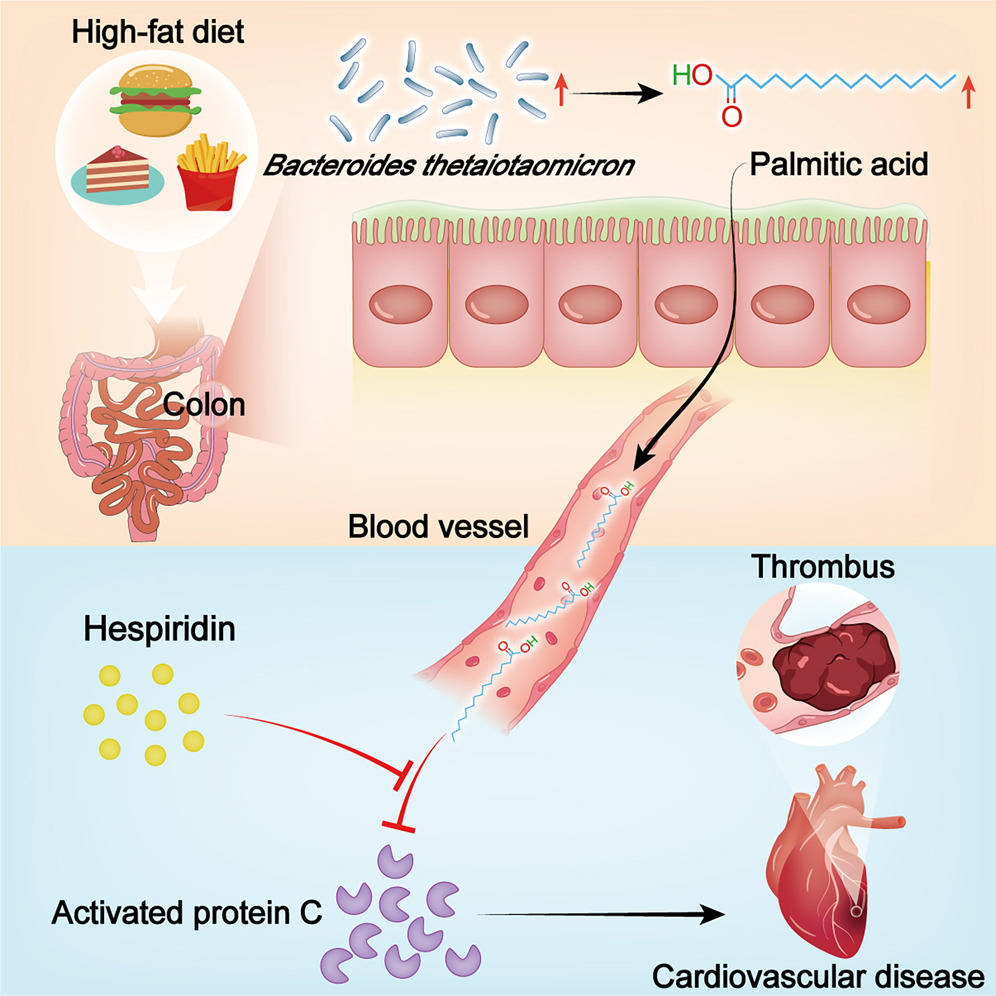
The mechanism of the high-fat diet-gut microbiota-palmitic acid axis in thrombosis. (Image by HUANG Xiaoshan)
<関連情報>
- https://english.cas.cn/newsroom/research_news/life/202508/t20250805_1049211.shtml
- https://www.cell.com/cell-reports-medicine/fulltext/S2666-3791(25)00333-7
高脂肪食は、腸内細菌Bacteroides thetaiotaomicronによって産生される循環中のパルミチン酸を増やし、血栓形成を促進する High-fat diet increases circulating palmitic acid produced by gut Bacteroides thetaiotaomicron to promote thrombosis
Xiaoshan Huang ∙ Xiaopeng Tang ∙ Qiuyue He ∙ … ∙ James Mwangi ∙ Heyu Ni, ∙ Ren Lai
Cell Reports Medicine Published:July 31, 2025
DOI:https://doi.org/10.1016/j.xcrm.2025.102260
Highlights
- PA has a direct procoagulant effect by inhibiting APC and enhancing platelet activation
- BT can produce PA
- HFD promotes the colonization of BT to increase circulating PA and exacerbate thrombosis
- Hesperidin blocks the interaction between PA and APC to prevent thrombosis induced by PA
Summary
Circulating palmitic acid (PA) is generally considered to be provided from diets and endogenous synthesis and is adversely correlated with cardiovascular disease (CVD). It is unknown, however, if gut microbiota modulates circulating PA and potentiates CVD risk. Here we demonstrate that, in CVD patients, elevated circulating PA is accompanied with hypercoagulability and high gut Bacteroides thetaiotaomicron (BT) abundance. PA promotes coagulation by inhibiting a major endogenous anticoagulant activated protein C (APC) and enhancing platelet activation. Importantly, BT is capable of synthesizing PA, and high-fat diet amplifies gut BT colonization. Our findings show that BT transplantation elevates plasma PA and triggers hypercoagulation without alternating host lipogenesis. Hesperidin, a dietary flavonoid, inhibits PA-APC interaction to prevent hypercoagulation induced by PA or BT transplantation. Collectively, we reveal the promotion of high-fat diet on gut BT colonization that elevates circulating PA and CVD risk, suggesting an approach controlling CVD by targeting PA and BT.