2025-08-13 アメリカ国立衛生研究所(NIH)
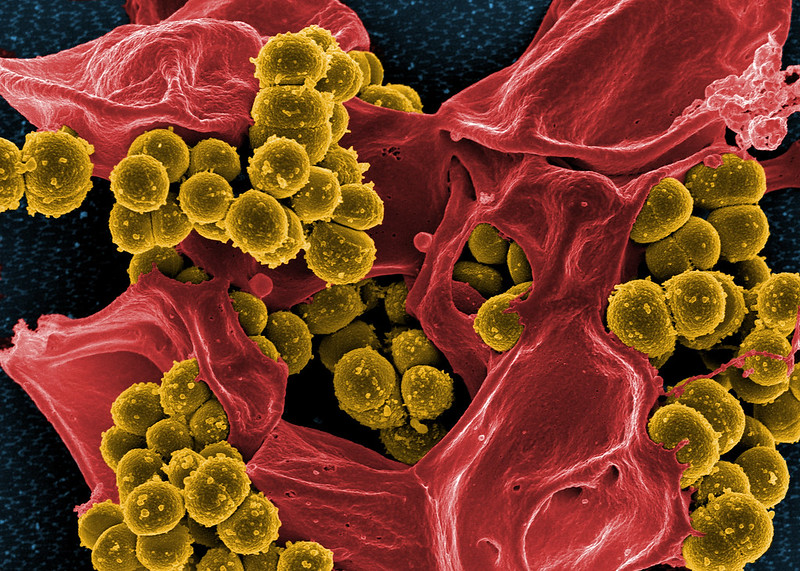 Colorized scanning electron micrograph of methicillin-resistant Staphylococcus aureus (MRSA) bacteria (gold) interacting with a human neutrophil (red). Image captured at NIAID’s Rocky Mountain Laboratories (RML) in Hamilton, Montana. NIAID
<関連情報>
- https://www.nih.gov/news-events/news-releases/two-dose-therapy-s-aureus-bloodstream-infections-par-standard-treatment
- https://jamanetwork.com/journals/jama/article-abstract/2837604
ダラブバンシンによる黄色ブドウ球菌血症の治療 DOTSランダム化臨床試験 Dalbavancin for Treatment of Staphylococcus aureus Bacteremia The DOTS Randomized Clinical Trial
Nicholas A. Turner, MD, MHSc; Toshimitsu Hamasaki, PhD; Sarah B. Doernberg, MD, MAS;et al
Journal of the American Medical Association Published:August 13, 2025
DOI:10.1001/jama.2025.12543
Key Points
Question Is dalbavancin a superior treatment option for complicated Staphylococcus aureus bacteremia compared with standard care?
Findings In this randomized clinical trial that included 200 adults completing therapy for complicated S aureus bacteremia, the probability of a more desirable outcome at day 70 with dalbavancin vs standard therapy was 47.7%, which did not achieve the prespecified criterion for superiority.
Meaning Among participants with complicated S aureus bacteremia who achieved blood culture clearance, dalbavancin was not superior to standard therapy for achieving a more desirable outcome at day 70.
Abstract
Importance Dalbavancin is a long-acting intravenous lipoglycopeptide that may be effective for treatment of complicated Staphylococcus aureus bacteremia without requiring long-term intravenous access.
Objective To evaluate the efficacy and safety of dalbavancin vs standard therapy for completion of treatment of complicated S aureus bacteremia.
Design, Setting, and Participants Open-label, assessor-masked, randomized clinical trial conducted from April 2021 to December 2023 at 23 medical centers in the US (n = 22) and Canada (n = 1). Participant follow-up lasted 70 days (180 days for participants with osteomyelitis); date of final follow-up was December 1, 2023. Hospitalized adults with complicated S aureus bacteremia who achieved blood culture clearance following at least 72 hours but no more than 10 days of initial antibacterial therapy were included. Participants were excluded if they had central nervous system infection, retained infected prosthetic material, left-sided endocarditis, or severe immune compromise.
Interventions Participants were randomly assigned to receive either 2 doses of intravenous dalbavancin (n = 100; 1500 mg on days 1 and 8) or 4 to 8 total weeks of standard intravenous therapy (n = 100; cefazolin or antistaphylococcal penicillin if methicillin susceptible; vancomycin or daptomycin if methicillin resistant).
Main Outcomes and Measures The primary outcome was the desirability of outcome ranking (DOOR) at day 70, which involved 5 components (clinical success, infectious complications, safety complications, mortality, and health-related quality of life) and was assessed for superiority (achieved if the 95% CI for the probability of dalbavancin having a superior DOOR was >50%). Secondary outcomes included clinical efficacy at day 70 (prespecified noninferiority margin of 20%) and safety.
Results Of 200 participants randomized (mean [SD] age, 56 [16.2] years; 62 females [31%]), 167 (84%) survived to day 70 and had an efficacy assessment. Participants without a day 70 efficacy assessment were treated as clinical failures in the analyses. The probability of a more desirable day 70 outcome with dalbavancin vs standard therapy was 47.7% (95% CI, 39.8% to 55.7%). Regarding secondary outcomes, clinical efficacy was documented in 73 of 100 for dalbavancin and 72 of 100 for standard therapy (difference, 1.0% [95% CI, -11.5% to 13.5%]), meeting the noninferiority criterion. Serious adverse events were reported in 40 of 100 participants who received dalbavancin and 34 of 100 participants who received standard therapy; treatment-related adverse events were uncommon in both groups.
Conclusions and Relevance Among adult participants with complicated S aureus bacteremia who achieved blood culture clearance, dalbavancin was not superior to standard therapy by desirability of outcome ranking. When considered with other efficacy and safety outcomes these findings may help inform use of dalbavancin in clinical practice.
Trial Registration ClinicalTrials.gov Identifier: NCT04775953