2025-08-27 国立精神・神経医療研究センター,浜松医科大学
<関連情報>
- https://www.ncnp.go.jp/topics/detail.php?@uid=8dJzfM16dLmVXEHF
- https://www.ncnp.go.jp/press_search/images/files/Pr_20250827.pdf
- https://www.nature.com/articles/s44184-025-00149-3
母体ストレス、臍帯血亜鉛濃度と注意欠陥・多動性障害 Maternal stress, cord blood zinc and attention deficit hyperactivity disorder
Nagahide Takahashi,Tomoko Nishimura,Akemi Okumura,Toshiki Iwabuchi,Taeko Harada,Md Shafiur Rahman,Yoko Nomura,Jeffrey H. Newcorn & Kenji J. Tsuchiya
npj Mental Health Research Published:07 August 2025
DOI:https://doi.org/10.1038/s44184-025-00149-3
Abstract
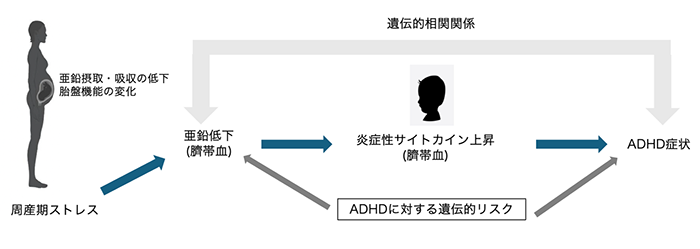
Zinc regulates dopaminergic signaling, and reduced serum zinc levels have been reported in individuals with ADHD. However, genetic associations between zinc and ADHD remain unclear. We examined this link using large-scale GWAS and molecular analyses across three cohorts: iPSYCH (14,584 ADHD cases and 22,492 controls), FAMHES (n = 1798), and the Hamamatsu Birth Cohort (n = 726). Two-sample Mendelian randomization revealed bidirectional associations between low serum zinc levels and ADHD diagnosis. Genetic correlation and polygenic risk score analyses supported this association. In the birth cohort, lower cord blood zinc were associated with higher ADHD symptom scores at ages 8–9. Zinc levels negatively correlated with IL-6 and maternal depressive symptoms. Directed acyclic graph analysis indicated that maternal stress increased IL-6, which reduced fetal zinc levels, linking to ADHD symptoms. These findings suggest low prenatal zinc may contribute to ADHD pathophysiology in genetically vulnerable children, potentially mediated by maternal stress and inflammation.