2025-09-03 カナダ・コンコルディア大学
<関連情報>
- https://www.concordia.ca/news/stories/2025/09/03/chronic-benzodiazepine-consumption-impacts-sleep-quality-in-older-adults-new-research-shows.html
- https://academic.oup.com/sleep/advance-article/doi/10.1093/sleep/zsaf168/8164643?login=false
慢性不眠症の高齢者における睡眠構造と脳波への、慢性的なベンゾジアゼピン系薬剤およびベンゾジアゼピン受容体作動薬の使用の影響 Effect of chronic benzodiazepine and benzodiazepine receptor agonist use on sleep architecture and brain oscillations in older adults with chronic insomnia
Loïc Barbaux, Aurore A Perrault, Nathan E Cross, Oren M Weiner, Mehdi Es-sounni, Florence B Pomares, Lukia Tarelli, Margaret McCarthy, Antonia Maltezos, Dylan Smith …
Sleep Published:17 June 2025
DOI:https://doi.org/10.1093/sleep/zsaf168
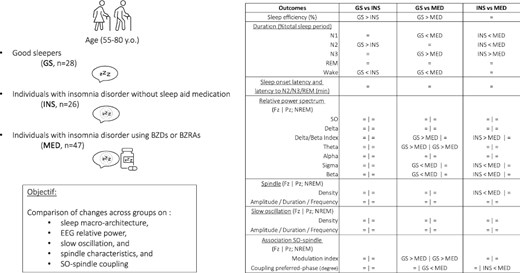
Graphical Abstract
Abstract
Study Objectives
Insomnia in older adults is associated with widespread benzodiazepine (BZD) and benzodiazepine receptor agonist (BZRA) use despite evidence that chronic use disrupts sleep regulation and cognition. Little is known about BZD/BZRA effects on Non-rapid eye movement (NREM) slow oscillations (SO), spindles and their coupling, which is crucial for memory in older adults. Our objective was to investigate the effects of chronic BZD/BZRA use on sleep macro-architecture, electroencephalogram (EEG) relative power, SO and spindle characteristics and coupling.
Methods
After habituation polysomnography, second-night data were analyzed from 101 participants (66.05 ± 5.84 years, range: 55–80 years, 73 per cent female) were categorized into three groups: good sleepers (GS, n = 28), individuals with insomnia (INS, n = 26) or individuals with insomnia who chronically use BZD/BZRA (MED, n = 47; diazepam equivalent: 6.1 ± 3.8 mg per use; >3 nights/week). We performed a comprehensive comparison of sleep architecture, EEG relative spectrum, and associated brain oscillatory activities, focusing on SO and spindles and their temporal coupling.
Results
MED showed disrupted sleep architecture with lower N3 and higher N1 duration and spectral activity and altered sleep-related brain oscillations synchrony, compared to INS and GS. An exploratory interaction model suggested that chronic use of higher doses (mg per use) correlated with more pronounced disruptions in sleep micro-architecture and EEG spectrum.
Conclusions
Our results suggest that chronic BZD and BZRA use is associated with poorer sleep quality. Such alteration of sleep regulation—at the macro and micro-architectural levels—may contribute to the reported association between BZD/BZRA use and cognitive impairment in older adults.
Statement of Significance
Widespread use of sedative-hypnotics is driven by high insomnia rates among older adults. Chronic use can disrupt cognitive function; however, its impact on sleep regulation is not well understood. We assessed the effect of chronic benzodiazepine use in older adults using a between-group design involving good sleepers, drug-free individuals with insomnia disorder and individuals with insomnia disorder who chronically use sedative-hypnotics as a sleep aid. We performed a comprehensive comparison of sleep architecture, electroencephalogram relative spectrum, and associated NREM brain oscillations related to memory consolidation. We showed that chronic use of sedative-hypnotics is detrimental to sleep regulation—at the macro and micro-level—and this may contribute to the reported link between sedative-hypnotic use and cognitive impairment in older adults.