2025-09-18 ミシガン大学
<関連情報>
- https://news.umich.edu/310-million-year-old-fossil-takes-a-bite-out-of-fish-evolution/
- https://royalsocietypublishing.org/doi/10.1098/rsbl.2025.0270
舌咬合器官が3億1000万年前の硬骨魚類における機能的革新を浮き彫りにする Tongue-bite apparatus highlights functional innovation in a 310-million-year-old ray-finned fish
Sam Giles,Matthew Kolmann and Matt Friedman
Biology Letters Published:03 September 2025
DOI:https://doi.org/10.1098/rsbl.2025.0270
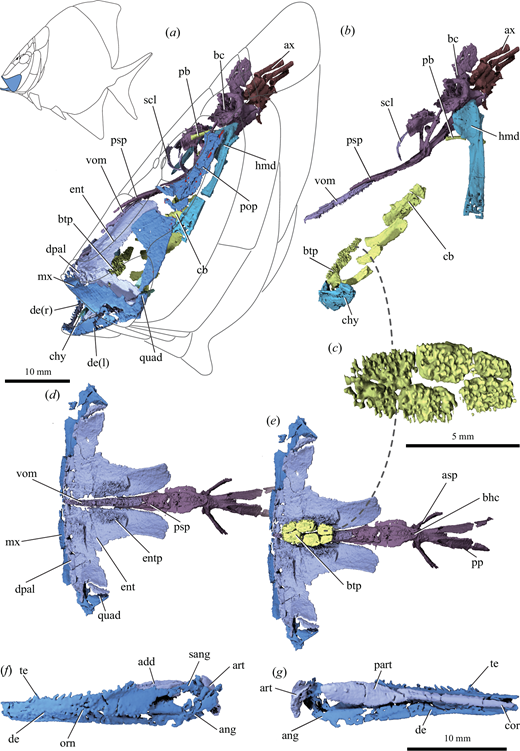
Abstract
Gill-skeleton modifications for processing prey represent a major source of functional innovation in living ray-finned fishes. Here we present the oldest actinopterygian tongue bite, derived from the gill skeleton, in the Middle Pennsylvanian (approx. 310 Ma) †Platysomus parvulus. Unrelated to extant tongue biters, this deep-bodied taxon possesses a large, multipartite basibranchial tooth plate opposing an upper tooth field centred on the vomer. This branchial structure occurs in conjunction with toothed jaws, indicating a role for both the basibranchial plate and jaws in feeding. †P. parvulus illustrates the assembly of the tongue bite in the geologically younger †Bobasatraniidae: large opposing dorsal (vomerine) and ventral (basibranchial) crushing plates associated with toothless jaws. The origin of tongue bites falls within the Carboniferous actinopterygian radiation, although it postdates the first signs of the consumption of hard prey (durophagy) in other ray-finned lineages by several million years. This lends support to a protracted model of actinopterygian diversification in the aftermath of the end-Devonian extinction.