
2025-09-24 国立長寿医療研究センター
<関連情報>
- https://www.ncgg.go.jp/ri/report/20250924.html
- https://www.ncgg.go.jp/ri/report/documents/20250924.pdf
- https://onlinelibrary.wiley.com/doi/10.1002/jcsm.70055
側視床下部のニコチンアミドアデニンジヌクレオチドリン酸リボシルトランスフェラーゼ(Nampt)は、雄マウスにおいて乳酸を介したカルシウムシグナル伝達を通じて骨格筋機能を維持する Nicotinamide phosphoribosyltransferase (Nampt) in Lateral Hypothalamus Maintains Skeletal Muscle Functions Through Lactate-Mediated Calcium Signalling in Male Mice
Takahiro Eguchi, Keiko Kabetani, Naoki Ito
Journal of Cachexia, Sarcopenia and Muscle Published: 16 September 2025
DOI:https://doi.org/10.1002/jcsm.70055
ABSTRACT
Background
Sarcopenia has become an urgent socioeconomic problem in rapidly aging societies. The pathogenesis of age-associated sarcopenia is not fully understood and no effective therapeutic strategies have been developed to date. Recent studies have suggested the importance of the functional linkage between the brain and skeletal muscles in the pathogenesis of sarcopenia. However, the functional connections between the brain and skeletal muscles, particularly between the hypothalamus and skeletal muscles, remain unclear. In this study, we focused on the importance of nicotinamide adenine dinucleotide (NAD+) metabolism in the lateral hypothalamus (LH) and explored the importance of the NAD+-mediated functional connection between the LH and skeletal muscle and its involvement in the pathogenesis of sarcopenia.
Methods
To explore the role of NAD+ in the LH, we knocked down nicotinamide phosphoribosyltransferase (Nampt), a rate-limiting enzyme in the NAD+ salvage pathway that is required for the maintenance of NAD+, by stereotaxic injection of a lentivirus encoding short hairpin RNA for Nampt into the LH.
Results
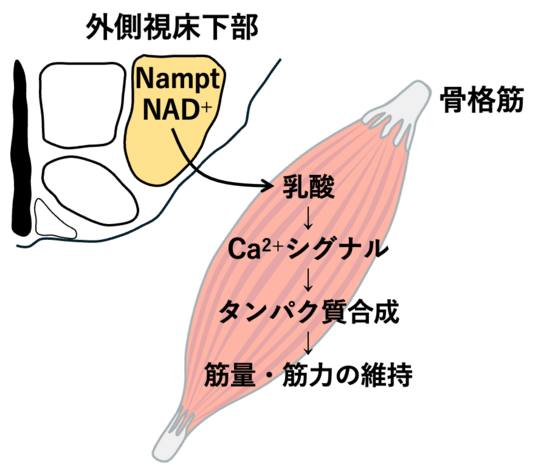
Loss-of-function of Nampt in the LH caused decreased muscle mass (mg/cm) [tibialis anterior: 24.8 ± 0.36 vs. 22.9 ± 0.29, p < 0.001; gastrocnemius: 65.7 ± 1.60 vs. 60.9 ± 0.65, p < 0.05] and strength (mN) [382.0 ± 10.4 vs. 345.7 ± 5.47 at 100 Hz stimulation, p < 0.01], accompanied by disruption of the p70S6K-S6 protein synthesis axis in skeletal muscle. Skeletal muscle of LH-specific Nampt-knockdown mice exhibited decreased levels of pyruvate and lactate, the end products of glycolysis and decreased levels of glucose metabolism-related genes, such as β2 adrenergic receptor (β2-AR), peroxisome proliferator-activated receptor delta (PPARδ), PPARγ and pyruvate dehydrogenase kinase 4 (PDK4). We identified lactate as a mediator linking decreased glycolysis and protein synthesis. Lactate induces increases in intracellular Ca2+ levels, which induce the activation of the p70S6K-S6 protein synthesis axis.
Conclusions
Our results indicate that Nampt in the LH maintains skeletal muscle function by regulating lactate-mediated Ca2+ signalling in skeletal muscle. Our study highlights the essential role of Nampt in the LH in the regulation of skeletal muscles and lactate as a mediator that links glycolysis and protein synthesis. As NAD+ levels in the LH decrease with age, our study provides new insights into the pathogenesis of sarcopenia.

