2025-09-26 京都大学
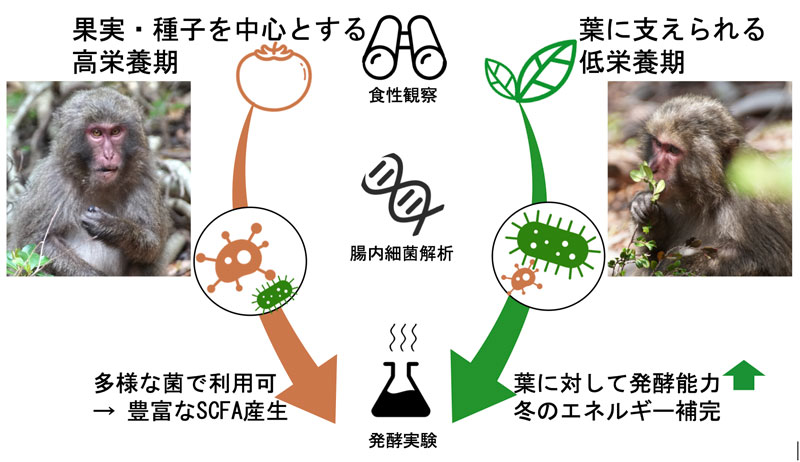 腸内細菌が支えるニホンザルの食性適応:屋久島での行動観察と糞試料の解析、さらに試験管内発酵実験により、腸内細菌叢が果実・種子には多様な菌で常に多くの短鎖脂肪酸を産生し、冬の低栄養期には葉の発酵能力を高めてエネルギーを補っていることが明らかになった。
<関連情報>
- https://www.kyoto-u.ac.jp/ja/research-news/2025-09-26-0
- https://www.kyoto-u.ac.jp/sites/default/files/2025-09/2509_Eco%26Evo_Lee_relj%20web-fcbd9ad032031f500ed077fd8c07e06f.pdf
- https://onlinelibrary.wiley.com/doi/10.1002/ece3.72076
ニホンザルにおける腸内マイクロバイオームの季節適応:腸内マイクロバイオームの変化と発酵機能の関連性 Seasonal Adaptation of the Gut Microbiome in Japanese Macaques: Linking Gut Microbiome Shifts With Fermentative Function
Wanyi Lee, Tianmeng He, Yosuke Kurihara, Izumi Shiroishi, Kazunari Ushida, Sayaka Tsuchida, Goro Hanya
Ecology and Evolution Published: 01 September 2025
DOI:https://doi.org/10.1002/ece3.72076
ABSTRACT
Seasonal fluctuations in food availability strongly influence the ecology of wild mammals, yet the role of the gut microbiome in mediating these challenges remains insufficiently explored. In this study, we examined how seasonal dietary shifts influence gut microbial composition and fermentative function in wild Japanese macaques (Macaca fuscata). Integrating meta-16S rRNA sequencing and in vitro fermentation assays, we investigated how the gut microbiome and the associated fermentative ability of Japanese macaques vary with seasonal dietary shifts. Although alpha diversity remained relatively stable throughout the year, significant changes in microbial composition revealed a flexible, seasonally responsive microbiome. Importantly, in vitro fermentation assays indicated that fermentative ability was stable across seasons for leaf fermentation but flexible for fermenting easily fermentable monkey chow. This dual strategy may represent an essential adaptive feature of the macaque gut microbiome, balancing metabolic stability and plasticity to effectively cope with seasonal dietary fluctuations. By linking microbial dynamics with dietary variation, this study provides new insights into the feeding ecology of Japanese macaques and highlights the essential role of gut microbiomes in supporting the ecological success of temperate primates.