2025-10-01 海洋研究開発機構,信州大学,東京大学
Web要約 の発言:
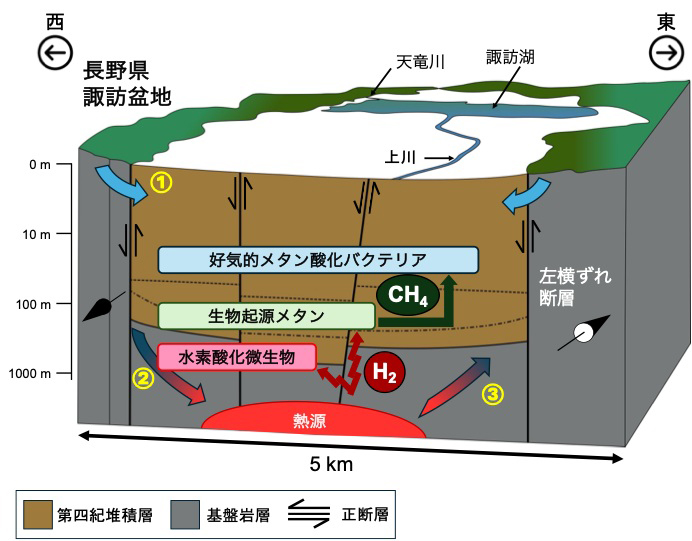
図4 本研究で推定された諏訪盆地の地下水流動プロセス。
*Sakakibara, Urai et al., J. Hydrol. 653, 132790, 2025.
<関連情報>
- https://www.jamstec.go.jp/j/about/press_release/20251001/
- https://progearthplanetsci.springeropen.com/articles/10.1186/s40645-025-00740-4
日本の諏訪盆地におけるメタンと水素に依存する原核生物深部生物圏:北米プレートとユーラシアプレートの境界における水文地質学的プロセスが地下原核生物生態に与える影響 Methane- and hydrogen-dependent prokaryotic deep biosphere at the Suwa Basin, Japan: impacts of hydrogeological processes on subsurface prokaryotic ecology at the boundary between the North American and the Eurasian Plates
Hiroki Nishimura,Atsushi Urai,Yohei Matsui,Toshihiro Yoshimura,Miyuki Ogawara,Hiroyuki Imachi,Yosuke Miyairi,Yusuke Yokoyama,Yuichi Miyabara,Yoshio Takahashi & Yoshinori Takano
Progress in Earth and Planetary Science PublishedDOI:https://doi.org/10.1186/s40645-025-00740-4
Abstract
The subsurface biosphere hosts diverse prokaryotes whose metabolic activities and roles in biogeochemical cycles remain unexplored. Specifically, interactions between subsurface prokaryotes and environmental characteristics are poorly constrained. The Suwa Basin, Japan, is a suitable setting for investigating the impacts of hydrogeological features on subsurface microbiology, as it lies at the boundary between the North American and Eurasian Plates and is associated with geological events. This basin consists of sedimentary layers overlying bedrock. Previous studies have reported active methane seepage from the deep subsurface, presumably supporting the metabolic activities of subsurface prokaryotes. Moreover, faults and hot springs in the basin contribute to the complex subsurface geochemistry. Consequently, diverse methane-dependent ecosystems are expected to arise in response to heterogeneous subsurface conditions. We conducted geochemical and microbiological community analyses on groundwater samples from the sedimentary layer (10–100 m below the surface, mbs) and hot spring samples from bedrock region (max. 1000 mbs). The isotopic profiles (δ13C and δD) of methane indicated a primary microbial origin. However, subsurface community analysis revealed that methanogens were not significant at 10–100 mbs in the sedimentary layer, whereas aerobic methane-oxidizing bacteria were predominant. These results suggested the presence of an ecological niche for methanogens in deeper, reducing environments. The microbial communities in the hot spring samples were dominated by hyperthermophilic hydrogenotrophs. H2 was contained in gas phase collected at hot spring sites (55.5 ppm), and its isotopic composition (- 736‰ VSMOW) suggested that H2 generation was driven by tectonic activity. Subsurface hydrogeological processes were investigated based on the 14C concentration of dissolved inorganic carbon, revealing the significant intrusion of young groundwater from surrounding mountainous areas into the basin. The Li/Na molar ratios of the groundwater and hot spring water samples suggested the recharge of deeply derived hydrothermal fluids into the sedimentary layer. Considering the potential role of fault surfaces as conduits for vertical material transport, the unique geological setting of the Suwa Basin potentially supports the growth of prokaryotes in the sedimentary layer through an increased nutrient supply (e.g., H2) from deep fluids. These findings provided new insights into subsurface methane-related microbial ecology and its hydrogeological controls.