
2025-10-15 長寿医療研究センター
Web要約 の発言:
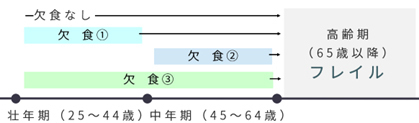
図1 壮年期から中年期にかけての欠食習慣の群分け
<関連情報>
- https://www.ncgg.go.jp/ri/report/20251001.html
- https://www.ncgg.go.jp/ri/report/documents/20251015.pdf
- https://www.sciencedirect.com/science/article/abs/pii/S1525861025004104
過去の食事欠食習慣は老後の身体的虚弱性と関連している:後ろ向きコホート研究 Past Meal-Skipping Habits Associate With Physical Frailty in Later Life: A Retrospective Cohort Study
Chiharu Nishijima PhD, Kenji Harada MSc, Satoshi Kurita PhD, Masanori Morikawa PhD, Kazuya Fujii PhD, Daisuke Kakita MSc, Hiroyuki Shimada PhD
Journal of the American Medical Directors Association Available online: 9 October 2025
DOI:https://doi.org/10.1016/j.jamda.2025.105893
Abstract
Objectives
Dietary intake is a crucial factor for healthy longevity. This study examined the association between meal-skipping habits in early and midlife and physical frailty in later life among community-dwelling older adults.
Design
A retrospective cohort study.
Setting and Participants
A total of 5063 older adults (aged ≥65 years) without dementia were included in the Japanese community cohort.
Methods
We assessed the number of meals per day in early and midlife and defined meal skipping as ≤2 meals per day. Referring to the revised version of the Cardiovascular Health Study criteria, physical frailty in this study included frailty and prefrailty. Binomial logistic regression analysis estimated the odds ratios (ORs) and 95% CIs for later-life physical frailty, adjusting for potential confounding factors. Additionally, analysis was conducted with meal-skipping groups categorized into 4 groups throughout early to midlife. Then, we further examined the association by subgroups based on current dietary status.
Results
In the fully adjusted model, meal-skipping habits in early and midlife were associated with later life physical frailty (OR, 1.64; 95% CI, 1.20–2.25 and OR, 2.15; 95% CI, 1.34–3.49, respectively). Participants who skipped meals in early life but quit meal skipping in midlife were not associated with later life physical frailty. Conversely, those who started meal skipping in midlife and those who continued meal skipping throughout early to midlife had a higher prevalence of physical frailty in later life (OR, 2.18; 95% CI, 1.07–4.71 and OR, 2.35; 95% CI, 1.53–3.70, respectively) than those without meal skipping. An association between midlife meal skipping and later-life physical frailty was observed even among individuals who discontinued meal skipping and adopted a 3-meal pattern in later life (OR, 2.96; 95% CI, 1.50–6.18).
Conclusions and Implications
To prevent physical frailty in later life, acquiring regular eating habits may be important, especially in midlife.

