2025-10-21 兵庫県立大学
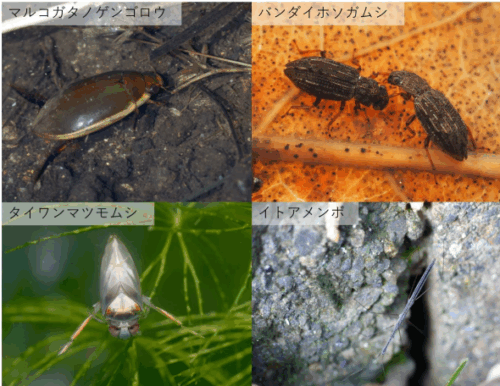
(図) 本研究で参照 DNA 配列を決定した水生昆虫の一部。いずれも平澤桂撮影。
<関連情報>
- https://www.u-hyogo.ac.jp/news/pressrelease/press20251021.html
- https://www.u-hyogo.ac.jp/20251021press.pdf
- https://zookeys.pensoft.net/article/146226/
環境 DNA メタバーコーディング分析に向けた日本産水生甲虫及びカメムシのミトコンドリア DNA の 16SrRNA 領域配列と証拠標本のコレクション Mitochondrial DNA 16S region and voucher specimen collection of Japanese aquatic Coleoptera and Hemiptera for environmental DNA metabarcoding analyses
Naoyuki Nakahama, Kei Hirasawa, Masaya Kato, Kohei Watanabe, Seikan Kurata, Masakazu Hayashi
Zookeys Published:23 Sep 2025
DOI:https://doi.org/10.3897/zookeys.1253.146226
Abstract
Aquatic coleopteran and hemipteran insects primarily inhabit lentic waters, many of which are at risk of extinction due to development, agriculture, and invasive alien species. Environmental DNA (eDNA) analysis has recently emerged as a powerful tool for conducting comprehensive distribution surveys. The cytochrome c oxidase subunit I (COI) universal primers are conventionally used for DNA barcoding but they often result in non-specific amplification and frequent amplication failures. Primers in the mitochondrial DNA (mtDNA) 16S rRNA region that alleviate these issues have been developed and are considered helpful for eDNA analysis. It is necessary to accumulate reference sequences of the mtDNA 16S rRNA region in aquatic coleopteran and hemipteran insects. However, molecular identification at the genus or species level remains challenging, as only a few of these insect groups in Japan have registered reference DNA sequences for both the mtDNA COI and 16S rRNA. Therefore, we constructed a comprehensive dataset of the mtDNA 16S rRNA region for these insects distributed in Japan. As a result of this study, we were able to obtain partial sequences of the mtDNA 16S rRNA region from 140 coleopteran taxa (35.5% of Japanese aquatic species or subspecies) and 58 hemipteran taxa (45.3% of Japanese aquatic species or subspecies). These voucher specimens were deposited in four research institutions. The DNA sequence datasets are expected to significantly contribute as an essential database for eDNA analysis and other DNA metabarcoding studies.