2025-10-22 アリゾナ大学
<関連情報>
- https://news.arizona.edu/news/extinction-rates-have-slowed-across-many-plant-and-animal-groups-study-shows
- https://royalsocietypublishing.org/doi/10.1098/rspb.2025.1717
絶滅危機の解明:近年の植物と動物の絶滅の速度、パターン、原因 Unpacking the extinction crisis: rates, patterns and causes of recent extinctions in plants and animals
Kristen E. Saban and John J. Wiens
Proceedings of the Royal Society B Published:15 October 2025
DOI:https://doi.org/10.1098/rspb.2025.1717
Abstract
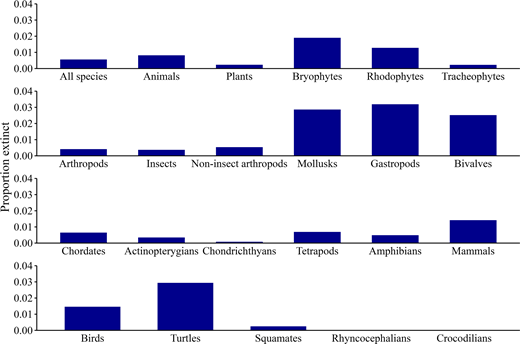
Biodiversity loss is one of the greatest challenges facing Earth today. The most direct information on species losses comes from recent extinctions. However, our understanding of these recent, human-related extinctions is incomplete across life, especially their causes and their rates and patterns among clades, across habitats and over time. Furthermore, prominent studies have extrapolated from these extinctions to suggest a current mass extinction event. Such extrapolations assume that recent extinctions predict current extinction risk and are homogeneous among groups, over time and among environments. Here, we analyse rates and patterns of recent extinctions (last 500 years). Surprisingly, past extinctions did not strongly predict current risk among groups. Extinctions varied strongly among groups, and were most frequent among molluscs and some tetrapods, and relatively rare in plants and arthropods. Extinction rates have increased over the last five centuries, but generally declined in the last 100 years. Recent extinctions were predominantly on islands, whereas the majority of non-island extinctions were in freshwater. Island extinctions were most frequently related to invasive species, but habitat loss was the most important cause (and current threat) in continental regions. Overall, we identify the major patterns in recent extinctions but caution against extrapolating them into the future.