2025-10-28 北海道大学
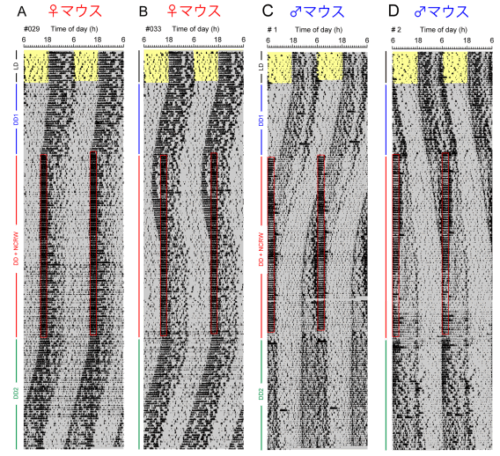
図 1. 習慣的な運動スケジュールに⾃発活動リズムが同調したマウスのアクトグラム典型例アクトグラムは、縦軸が⽇数、横軸が時刻を 2 ⽇分、⿊で⽰した時間帯が活動量を⽰している。
<関連情報>
- https://www.hokudai.ac.jp/news/2025/10/post-2107.html
- https://www.hokudai.ac.jp/news/pdf/251028_pr.pdf
- https://journals.physiology.org/doi/abs/10.1152/ajpregu.00194.2025
新奇環境下の輪回し運動がメスマウスの体内時計に与える影響:非光同調と位相変化の検証 Nonphotic Entrainment and Phase-Shifting of Circadian Rhythms by Novelty-Induced Wheel Running in Female Mice
Ren Y. Sato and Yujiro Yamanaka
American Journal of Physiology-Regulatory, Integrative and Comparative Physiology Published:20 October 2025
DOI:https://doi.org/10.1152/ajpregu.00194.2025
Abstract
Environmental light–dark (LD) cycles serve as the primary zeitgeber for the mammalian circadian system, but scheduled physical activity such as voluntary wheel running can act as a potent nonphotic cue. Previous studies on nonphotic entrainment have predominantly used male animals, leaving sex-specific mechanisms largely unexplored. In this study, we investigated circadian behavioral entrainment and phase-shifting responses to scheduled wheel-running activity in female C57BL/6J mice under constant darkness (DD). Mice underwent scheduled daily exposure to a novel cage with a running wheel (NCRW) for 3 hours, and spontaneous locomotor rhythms were analyzed before, during, and after exposure. Fifteen of 16 female mice achieved steady-state entrainment when the NCRW schedule coincided with activity onset. However, they lacked both anticipatory behavior and behavioral after-effects of entrainment–defined as persistent changes in circadian period and activity timing following entrainment–unlike what has been previously reported in males. To interpret entrainment dynamics, we constructed phase response curve (PRC) for a single 3-hour pulse of exposure to NCRW in both sexes. Female PRC displayed prominent delay portions in the late subjective day and early subjective night, contrasting with male profiles showing minor advances in the same windows. These findings reveal a sex difference in nonphotic circadian entrainment and suggest that underlying mechanisms, including oscillator coupling or differential sensitivity to nonphotic stimuli, may vary between males and females. The results emphasize the importance of considering biological sex in circadian research and provide a basis for further investigation into sex-specific regulation of behavioral rhythms.