
2025-10-29 カリフォルニア大学バークレー校 (UCB)
Web要約 の発言:
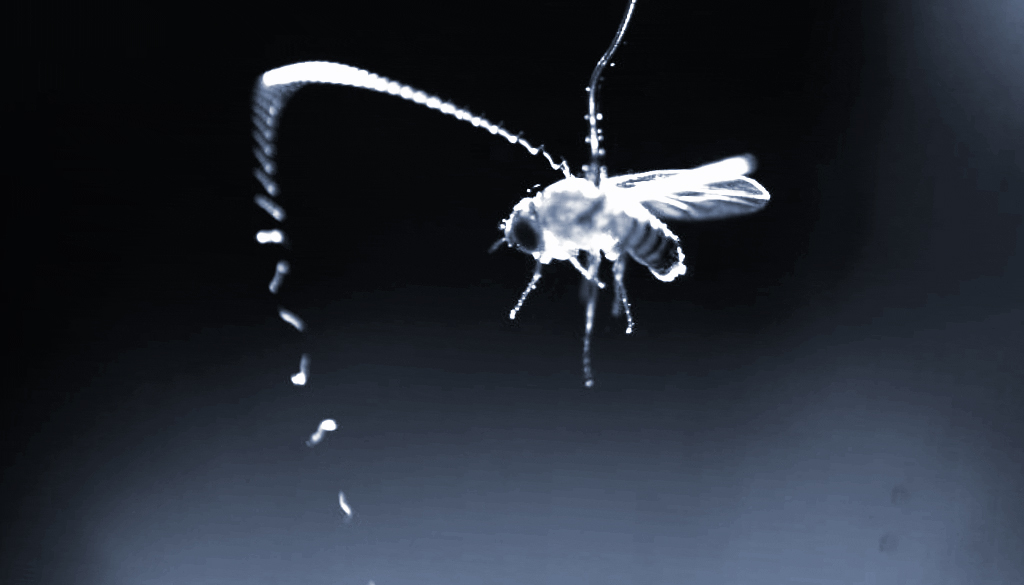
A strobed, time-lapse image of a parasitic nematode landing on a fly after launching itself into the air. The fly, which naturally develops an electrical charge while flying, induces an opposite charge in the nematode that draws the worm toward it — an ultimately fatal encounter for the fly. Victor Ortega-Jiménez/UC Berkeley
<関連情報>
- https://news.berkeley.edu/2025/10/29/parasitic-worms-rely-on-static-electricity-to-find-prey-in-midair/
- https://www.pnas.org/doi/10.1073/pnas.2503555122
寄生性跳躍線虫における空中宿主付着を促進する静電気 Electrostatics facilitate midair host attachment in parasitic jumping nematodes
Ranjiangshang Ran, Justin C. Burton, Sunny Kumar, +2 , and Victor M. Ortega-Jimenez
Proceedings of the National Academy of Sciences Published:October 14, 2025
DOI:https://doi.org/10.1073/pnas.2503555122
Significance
Entomopathogenic nematodes (EPNs) are important model organisms and natural biopesticides. Some EPNs exhibit explosive jumping behavior, enabling them to reach distant insect hosts. Our work reveals that jumping EPNs can be electrostatically attracted to charged hosts, such as fruit flies, increasing the likelihood of infection. Experiments show that host attachment is significantly enhanced by electrostatic forces generated by naturally occurring electric fields from flying insect hosts. Our computational model confirms that the static charge on EPNs agrees with theoretical predictions from electrostatic induction. We propose that electrostatics play a crucial role in enhancing the survival of these jumping parasites and provide a framework for modeling environmental forces in aerial parasite–host interactions.
Abstract
Jumping can be hazardous for entomopathogenic nematodes (EPNs) as those that fail to attach to an insect host face death by predation or starvation. Recently, it has been shown that electrostatic charges on large insects can prompt a close-range detachment of free-living nematodes, which are nonparasitic and unable to jump. However, it remains unclear if static electricity can influence aerial interactions between parasitic jumping worms and their insect hosts. Here, we analyze and model the trajectories of jumping EPNs in still air as they approach fruit flies with varying electrostatic charge. We find that the nematodes’ attachment to the host is facilitated by an electrical potential of a few hundred volts, a magnitude commonly found in flying insects. A model combining electrostatics, aerodynamics, and Bayesian inference indicates that the electrostatic charge on jumping nematodes is ~0.1 pC, which aligns with theoretical predictions for electrostatic induction. Drag coefficients based on host–nematode interactions in the presence of horizontal wind show differences at both low and high jumping velocities. Numerical simulations show that intermediate wind speeds (~0.2 m/s) can further increase the likelihood of host attachment, as wind-driven aerial drifting allows the worms to reach hosts at greater distances. Our results suggest that submillimeter parasites that become airborne may exploit the electric charge carried by their host to facilitate attachment and thus enhance survival. The use of quantitative physical models provides valuable insights into understanding complex airborne infectious diseases mediated by natural environmental forces.

