2025-11-06 チャルマース工科大学
<関連情報>
- https://news.cision.com/chalmers/r/bowel-cancer-s–big-bang–moment-revealed,c4263010
- https://www.nature.com/articles/s41588-025-02349-1
大腸癌の進化におけるエピジェネティック駆動と早期免疫回避 Epigenetically driven and early immune evasion in colorectal cancer evolution
Eszter Lakatos,Vinaya Gunasri,Luis Zapata,Jacob Househam,Timon Heide,Nicholas Trahearn,Ottilie Swinyard,Luis Cisneros,Claire Lynn,Maximilian Mossner,Chris Kimberley,Inmaculada Spiteri,George D. Cresswell,Gerard Llibre-Palomar,Miriam Mitchison,Carlo C. Maley,Marnix Jansen,Manuel Rodriguez-Justo,John Bridgewater,Ann-Marie Baker,Andrea Sottoriva &Trevor A. Graham
Nature Genetics Published:05 November 2025
DOI:https://doi.org/10.1038/s41588-025-02349-1
Abstract
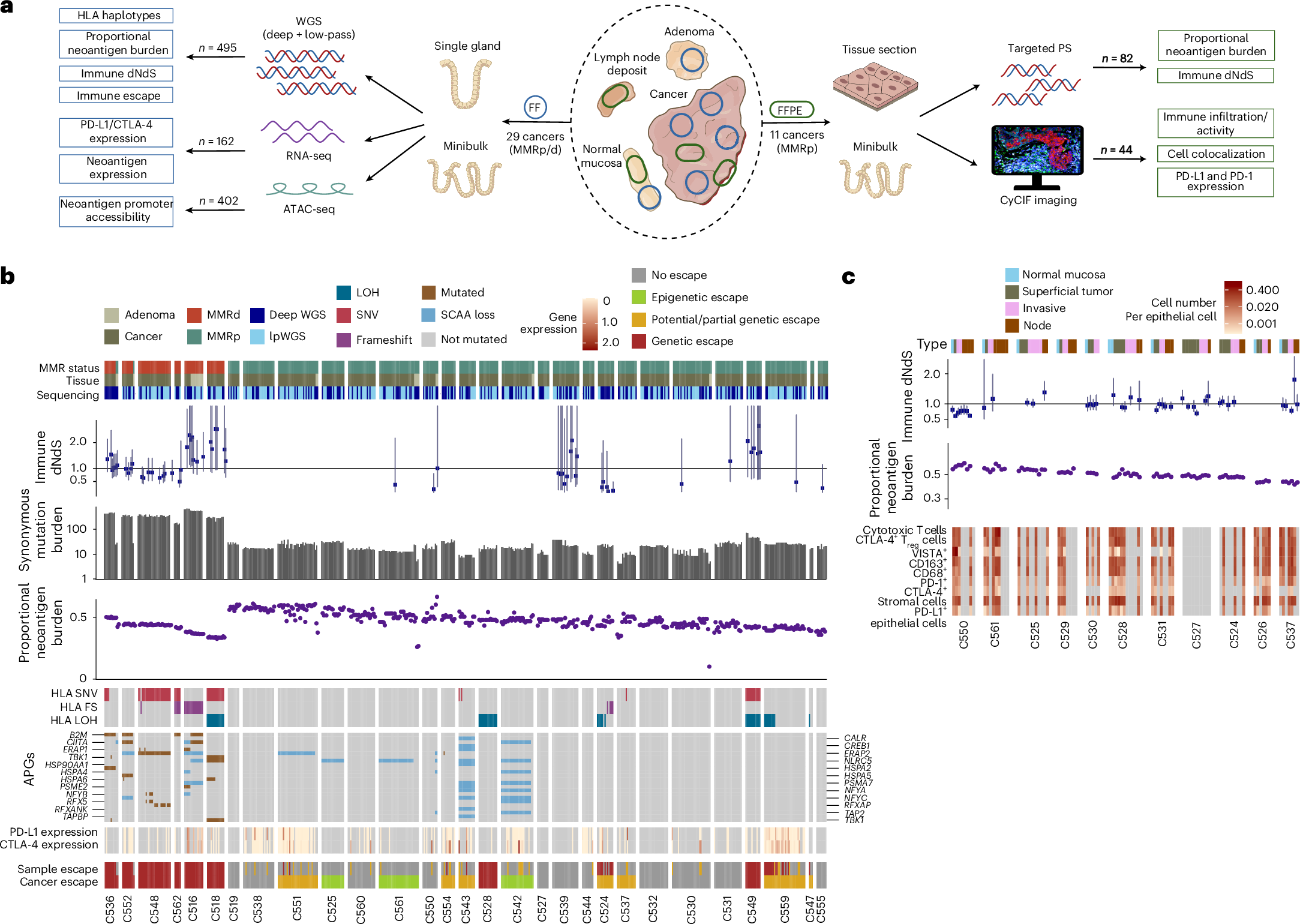
Immune system control is a principal hurdle in cancer evolution. The temporal dynamics of immune evasion remain incompletely characterized, and how immune-mediated selection interrelates with epigenome alteration is unclear. Here we infer the genome- and epigenome-driven evolutionary dynamics of tumor-immune coevolution within primary colorectal cancers (CRCs). We utilize a multiregion multiomic dataset of matched genome, transcriptome and chromatin accessibility profiling from 495 single glands (from 29 CRCs) supplemented with high-resolution spatially resolved neoantigen sequencing data and multiplexed imaging of the tumor microenvironment from 82 microbiopsies within 11 CRCs. Somatic chromatin accessibility alterations contribute to accessibility loss of antigen-presenting genes and silencing of neoantigens. Immune escape and exclusion occur at the outset of CRC formation, and later intratumoral differences in immuno-editing are negligible or exclusive to sites of invasion. Collectively, immune evasion in CRC follows a ‘Big Bang’ evolutionary pattern, whereby it is acquired close to transformation and defines subsequent cancer-immune evolution.